Passing the cottage to your kids is usually a tax event. When you die, the CRA treats you as having sold the cottage at fair market value immediately before death, and half of any gain is taxed on your final return, unless the cottage goes to a surviving spouse. If the cottage goes through your Ontario estate, estate administration tax of 1.5% on value over $50,000 can apply too. The tax can be planned for, but not wished away.
Key takeaways
- Canada has no inheritance tax, but the deceased is deemed to sell the cottage at fair market value.
- Leaving the cottage to a spouse or common-law partner can defer the tax until the survivor dies or sells.
- Giving the cottage to your kids while you’re alive is also treated as a sale at fair market value.
- Ontario’s estate administration tax is $15 per $1,000 of estate value over $50,000.
- Families commonly use life insurance, trusts, co-ownership agreements or a planned sale to handle the cost.
What happens to a cottage when you die?
The CRA’s rules for capital gains in the year of death say a person is considered to have sold all their capital property just before death. For a cottage left to children or anyone other than a spouse, the deemed sale price is fair market value. The gain is reported on the deceased’s final return and the estate pays the tax before the cottage can be distributed.
The spousal rollover
If the cottage goes to a surviving spouse or common-law partner who is a Canadian resident, or to a qualifying spousal trust, the transfer can happen at the original cost, with no tax at the first death. The gain is deferred until the survivor sells or dies. The property must vest in the spouse within 36 months of death, and the executor can choose to elect out of the rollover property by property if that helps.
For most families, that means the tax bill arrives at the second death, when the cottage passes to the next generation.
What it can cost: a worked example
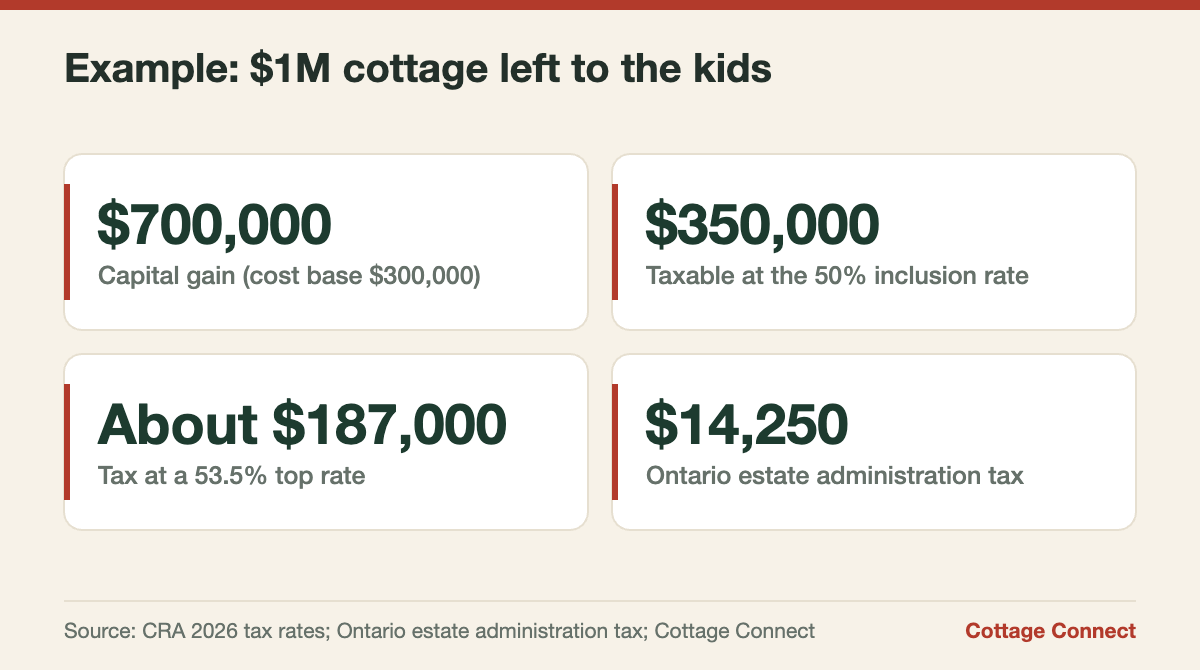
Say a parent’s cottage is worth $1,000,000 at death, and its adjusted cost base (purchase price plus purchase costs and capital improvements) is $300,000.
| Item | Amount |
|---|---|
| Fair market value at death | $1,000,000 |
| Adjusted cost base | $300,000 |
| Capital gain | $700,000 |
| Taxable capital gain (50%) | $350,000 |
| Tax if all taxed at about 53.5% | About $187,000 |
| Ontario estate administration tax ($1M estate) | $14,250 |
The 53.5% figure is Ontario’s top combined rate, based on the CRA’s 2026 brackets with Ontario’s surtax. A $350,000 taxable gain on a final return will be taxed mostly at or near that rate. The estate administration tax is calculated on the whole estate going through probate, so a larger estate pays more; here we’ve shown only the cottage.
Ontario’s estate administration tax is $15 for every $1,000 of estate value above $50,000, for applications made since January 1, 2020. Real estate outside Ontario isn’t included. If the principal residence exemption is available for some years, the estate can designate the cottage on the final return, which we explain in capital gains on a cottage.
Your main options compared
| Option | Tax timing | Main advantage | Main risk |
|---|---|---|---|
| Leave it in your will | At death (or second death) | Simple, you keep control | Estate needs cash for the tax and probate |
| Sell or gift it to the kids now | Now, at fair market value | Future growth is theirs | Tax today, loss of control, exposure to their creditors or separations |
| Add the kids to title | Now, on the share transferred | May reduce probate on that share | Courts may treat it as held in trust for your estate unless intent is documented |
| Family trust | Usually on transfer into the trust | Control over use and future owners | Setup and filing costs; trusts face a deemed sale every 21 years |
| Life insurance | No change; pays the bill at death | Keeps the cottage in the family without a forced sale | Premiums, and coverage must be in place before health issues |
Gifting or selling to children now
A gift to a child is treated as a sale at fair market value, so the tax comes due now, at today’s value. A sale at a family price below market value is worse for the parent: the parent is still taxed as if they sold at full value, while the child’s cost base is only what they paid. Get advice before agreeing on any family price, and note that land transfer tax is based on the consideration paid, as we explain in land transfer tax on a cottage.
Trusts
Putting the cottage in a trust usually triggers the gain at the time of transfer, though people aged 65 and older can use specific types of trusts that defer it. Trusts are generally deemed to sell their capital property every 21 years, which needs planning of its own. A trust can be useful when there are several children, blended families or a desire to keep the cottage for grandchildren.
Life insurance
Many families buy a joint last-to-die policy sized to the expected tax. The payout arrives when the tax is due, so no one has to sell the cottage or borrow to keep it. Get quotes while you’re healthy.
The family question comes first
Tax is the predictable part. The harder question is whether your children want the cottage, can afford their share of the upkeep, and can agree on how to use it. One child may live two hours away and use it every weekend; another may live overseas.
A written co-ownership agreement covering use, costs, buyouts and what happens on a divorce or death prevents most disputes. Our post on cottage co-ownership with family covers what to include.
How to start a cottage succession plan
Most families put this off until a health scare forces it. Starting early gives you more options, including insurance and gradual transfers. A practical order of work:
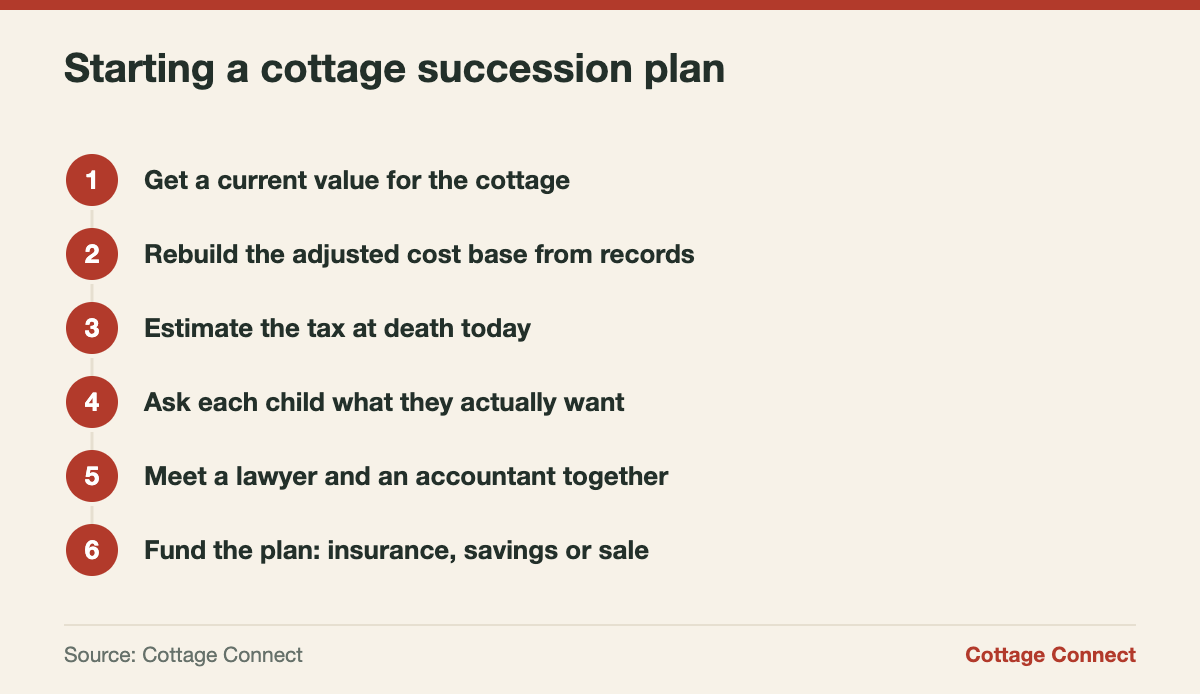
- Get a current value for the cottage from a recent sales comparison or appraisal.
- Rebuild the adjusted cost base from your purchase records and improvement receipts.
- Estimate the tax if you died this year, and how the estate would pay it.
- Ask each child, separately and honestly, whether they want to own part of it.
- Meet with an estate lawyer and an accountant together, not one after the other.
- Decide how the plan will be funded: insurance, savings, a sale or a buyout.
Tip: Ask for a value estimate of the cottage now, and keep it with your estate papers. It gives your accountant a starting point for the tax projection, and if you buy insurance, it helps you choose a coverage amount that matches the real bill rather than a guess.
Frequently asked questions
Do you pay tax when you inherit a cottage in Canada?
The person inheriting doesn’t pay an inheritance tax. Instead, the deceased is treated as selling the cottage at fair market value just before death, and the tax on the gain is paid by the estate through the final return. The child receives the cottage with a cost base equal to that fair market value.
Can I avoid capital gains by gifting the cottage to my kids?
No. A gift is treated as a sale at fair market value, so the tax is triggered now rather than at death. Selling to a child for less than market value can be worse, because the parent is taxed on full value while the child’s cost base is only the price paid. Get tax advice first.
Is probate charged on a cottage in Ontario?
If the cottage is in Ontario and goes through the estate, it’s included in the value for Ontario’s estate administration tax, charged at $15 per $1,000 above the first $50,000. Real estate outside Ontario isn’t included. Some ownership structures can keep a cottage out of the estate, but each has trade-offs.
Can I leave the cottage to my spouse tax-free?
Generally, yes for now. A cottage left to a Canadian-resident spouse or common-law partner, or a qualifying spousal trust, can roll over at the original cost, deferring the tax until the survivor sells or dies. The property must vest within 36 months of death, and the executor can elect out if that helps.
Plan with real numbers
Get a current figure with our cottage value estimate, and if a sale turns out to be the right answer, our post on selling a cottage in the fall or spring covers timing.
This article is general information as of October 2026, not legal, tax, mortgage or financial advice. Rules and numbers change, so confirm the details for your situation with a licensed professional.