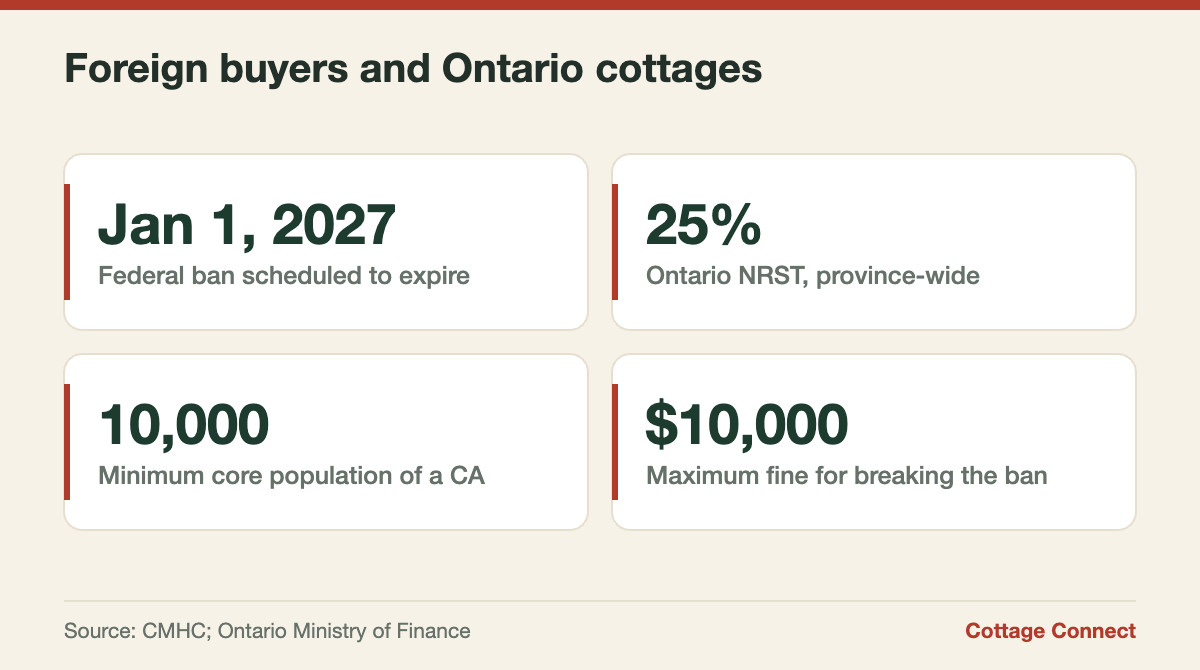
Often, yes. Canada’s ban on foreign buyers, which runs until January 1, 2027, only applies to residential property inside a census metropolitan area (CMA) or census agglomeration (CA), and many Ontario cottages sit outside those boundaries. But Ontario’s 25% Non-Resident Speculation Tax applies across the whole province, so an American buying a $650,000 cottage would pay $162,500 in NRST on top of land transfer tax.
Key takeaways
- The federal foreign buyer ban covers residential property only inside CMAs and CAs.
- Cottages and vacation homes outside those areas are exempt; inside them, they’re covered.
- Several cottage-country communities are census agglomerations, including Kawartha Lakes, Orillia, Midland and Collingwood.
- Ontario’s 25% NRST applies to foreign buyers everywhere in the province, cottage or not.
- The ban is scheduled to expire on January 1, 2027; what replaces it hasn’t been announced.
How Canada’s foreign buyer ban works
The Prohibition on the Purchase of Residential Property by Non-Canadians Act took effect on January 1, 2023. It was extended in February 2024 and is now scheduled to expire on January 1, 2027. It bars non-Canadians, and corporations they control, from buying residential property, directly or indirectly.
Canadian citizens, permanent residents and people registered under the Indian Act aren’t affected. There are exceptions for some temporary residents, refugees and protected persons, and non-Canadians buying jointly with a Canadian spouse or partner. Property acquired through a gift, inheritance, divorce or separation isn’t covered.
The penalties are real. According to CMHC’s guidance on the Act, a non-Canadian who breaks the rule, or anyone who knowingly helps, can be fined up to $10,000, and a court can order the property sold, with the buyer receiving no more than the price paid.
The cottage exception: outside CMAs and CAs
The regulations include an exception for any residential property outside a CMA or CA, using Statistics Canada’s 2021 boundaries. CMHC’s guidance says summer cottages and vacation homes follow the same location test: outside a CMA or CA they’re exempt, inside one they’re covered.
- Census metropolitan area: a total population of at least 100,000, with at least 50,000 in the core.
- Census agglomeration: a core population of at least 10,000.
Cottage country is not automatically outside these areas. Statistics Canada’s 2021 list of Ontario census agglomerations includes Kawartha Lakes, Orillia, Midland, Collingwood, Wasaga Beach, Owen Sound, Cobourg, Port Hope, North Bay, Petawawa and Pembroke. The City of Kawartha Lakes is a large municipality with a lot of waterfront, so a cottage there may well be inside a CA.
| Where the cottage is | Federal foreign buyer ban | Ontario NRST (25%) |
|---|---|---|
| Outside any CMA or CA | Doesn’t apply | Applies |
| Inside a CA (for example, Kawartha Lakes or Orillia) | Applies unless an exception fits | Applies |
| Inside a CMA | Applies unless an exception fits | Applies |
The only reliable test is the address. CMHC provides a map tool where you enter the property address to see whether it falls inside a CMA or CA. Do this before you book a showing, not after you’ve written an offer.
Ontario’s Non-Resident Speculation Tax on cottages
The NRST is a provincial tax, separate from the federal ban, and it has no cottage exception. Since October 25, 2022, Ontario’s NRST has applied at 25% across the province when a foreign national, foreign corporation or taxable trustee buys residential property with one to six units.
On a $650,000 cottage, the cost looks like this:
- NRST at 25%: $162,500
- Ontario land transfer tax: $9,475
- Total land taxes: $171,975, before legal fees and other closing costs
Both are due on closing. Our guide to land transfer tax on a cottage shows the provincial tax at other price points. Ontario’s NRST rules include limited exemptions and rebates, for example for nominees under the Ontario Immigrant Nominee Program and for some buyers with a Canadian citizen or permanent resident spouse, so ask your lawyer whether any fit your situation.
What happens after January 1, 2027?
Nobody knows yet. As of early October 2026, the federal government hadn’t announced an extension or a replacement. MoneySense reported on October 2, 2026 that the housing minister confirmed a formal review in December 2025 and that most analysts don’t expect the ban to be extended in its current form. Options under discussion include allowing foreign purchases of new projects or vacant land but not existing homes, and extra taxes on foreign buyers.
Even if the federal ban expires, the NRST stays unless Ontario changes it. For a non-Canadian, the 25% tax is the bigger cost on most cottages either way.
Other things American cottage buyers should know
- Financing. Canadian lenders treat non-resident borrowers differently, and you should expect a larger down payment and more paperwork. Our post on cottage mortgage rules for 2026 covers the domestic rules for comparison.
- Underused Housing Tax. This federal tax on vacant or underused homes owned by non-residents has been eliminated for 2025 and later years, although obligations for 2022 to 2024 still apply.
- Renting it out. Non-residents who earn Canadian rental income face withholding and filing rules, and local short-term rental bylaws apply to everyone. Get cross-border tax advice before you count on rental income.
- Selling later. When a non-resident sells Canadian real estate, the buyer’s lawyer may hold back part of the price until the CRA issues a clearance certificate. Plan for it.
Steps before you make an offer
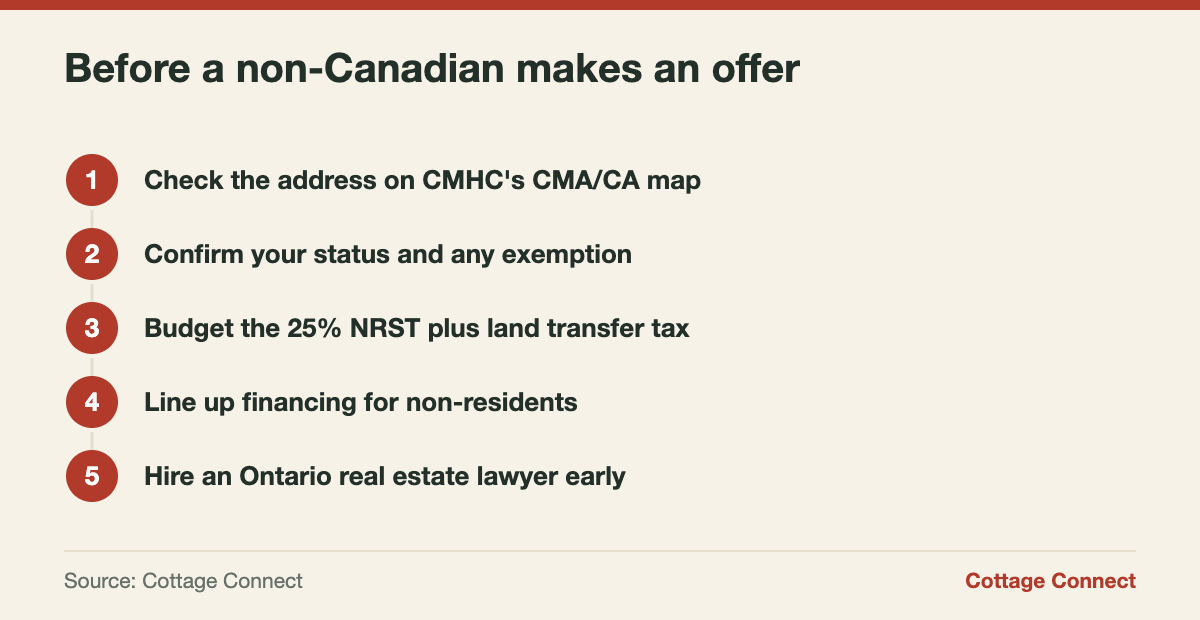
- Enter the cottage address in CMHC’s CMA/CA map tool and save the result.
- Confirm your status: citizen, permanent resident, temporary resident or foreign national. Note too if a Canadian spouse will be on title.
- Budget the 25% NRST plus land transfer tax as cash due on closing.
- Talk to a lender that works with non-resident borrowers.
- Hire an Ontario real estate lawyer before you sign, and a cross-border accountant for the tax side.
Tip: Two cottages on the same lake can fall on opposite sides of a census boundary. If you’re a non-Canadian buyer, ask your agent to check every address on CMHC’s map before you shortlist, and keep a copy of the result for your lawyer.
Frequently asked questions
Can a US citizen buy property in Canada in 2026?
Yes, with limits. Until January 1, 2027, non-Canadians can’t buy residential property inside census metropolitan areas or census agglomerations unless an exception applies. Property outside those areas, including many cottages, can be bought. In Ontario, a foreign buyer also pays the 25% Non-Resident Speculation Tax on residential property anywhere in the province.
Does the foreign buyer ban apply to cottages?
Only if the cottage is inside a CMA or CA. CMHC’s guidance says summer cottages and vacation homes outside those areas are exempt, while those inside are covered. Some cottage-country communities, such as Kawartha Lakes and Orillia, are census agglomerations, so check each address on CMHC’s map tool.
Do Americans pay the NRST on an Ontario cottage?
Yes, unless an exemption applies. Ontario’s Non-Resident Speculation Tax is 25% of the price and has applied province-wide since October 25, 2022, to foreign nationals buying residential property with one to six units. It’s charged in addition to the regular land transfer tax and is due on closing.
Will the foreign buyer ban end in 2027?
It’s scheduled to expire on January 1, 2027. As of early October 2026, Ottawa hadn’t announced an extension, and reporting suggested a replacement framework was more likely than a clean expiry. Ontario’s 25% NRST is separate and would continue unless the province changes it.
Shopping from across the border?
Compare areas with our regional price guide, browse cottages for sale, and contact our team before you make plans around a specific property.
This article is general information as of October 2026, not legal, tax, mortgage or financial advice. Rules and numbers change, so confirm the details for your situation with a licensed professional.