How much a cottage costs per year depends on the property, but in our example a four-season Ontario cottage runs about $16,100 a year before the mortgage, once you add property tax, insurance, hydro, heating, internet, road fees, upkeep and a reserve for the septic system. Seasonal cottages cost less to heat but add opening and closing costs. The best way to get a real number is to ask the seller for 12 months of bills and price the rest yourself.
Key takeaways
- Our example four-season cottage costs about $16,100 a year to run, or about $1,345 a month, before the mortgage.
- Property tax is based on MPAC values as of January 1, 2016, so the assessed value is often well below today’s price.
- A septic system is a long-term liability: set aside a reserve every year, not just for pump-outs.
- Private roads, docks and shoreline work are the costs city buyers most often miss.
- Insist on the seller’s actual bills; estimates are no substitute.
An example annual cottage budget
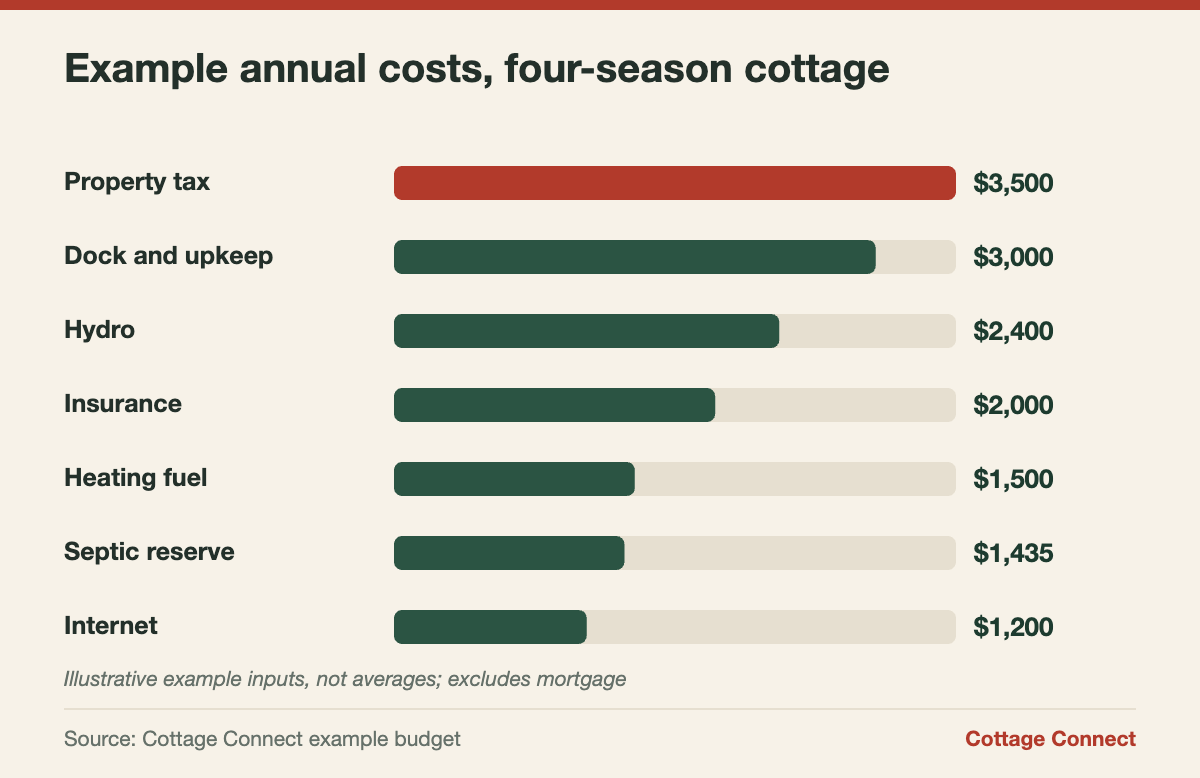
The table below is an illustration, not an average. It assumes a winterized, road-access cottage bought for about $650,000. Every number is an example input you should replace with real bills and quotes for the cottage you’re considering.
| Cost | Example per year | How to check it |
|---|---|---|
| Property tax | $3,500 | Seller’s latest tax bill or a tax certificate |
| Insurance | $2,000 | Broker quote before you firm up |
| Hydro | $2,400 | 12 months of the seller’s bills |
| Heating fuel (propane, oil or wood) | $1,500 | Delivery records |
| Internet | $1,200 | Provider availability at the address |
| Septic pump-out ($500 every 5 years) | $100 | Pump-out receipts and local quotes |
| Septic replacement reserve | $1,435 | System age and permit records |
| Road association and plowing | $1,000 | Association statements |
| Dock, shoreline and general upkeep | $3,000 | Inspection report and contractor quotes |
| Total before mortgage | $16,135 | About $1,345 a month |
Add the mortgage and the picture changes. In our post on cottage mortgage rules for 2026, a $600,000 four-season cottage with the minimum insured down payment carried a payment of about $3,282 a month. Together with this budget, that’s more than $55,000 a year. Try your own numbers in our cottage calculators.
Property tax on a cottage
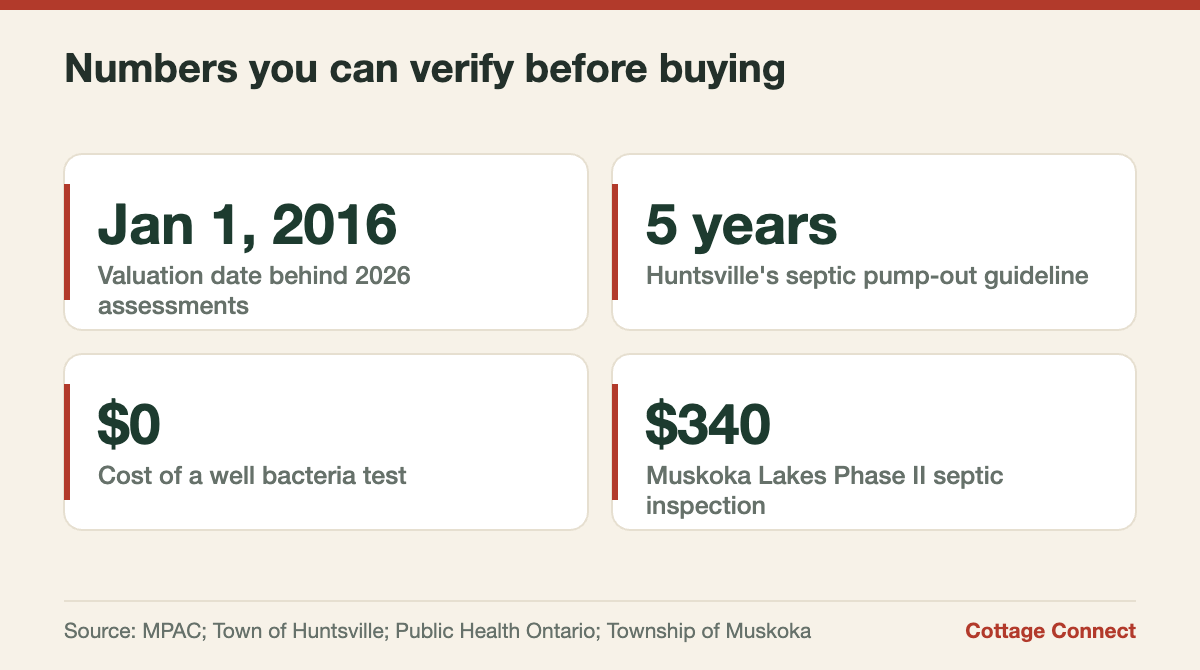
Property tax is your assessed value multiplied by the combined tax rate (municipal, upper-tier and education). In Ontario, assessments for the 2026 tax year are still based on January 1, 2016 values, because the province postponed the reassessment. A cottage bought for $650,000 today may be assessed for much less.
Rates change every year. The Township of Muskoka Lakes, for example, adopted an 8.6% increase in its municipal tax rate for 2026, which it said works out to about $13.85 more per $100,000 of residential assessment. In Muskoka, the township’s share is only part of the bill: in 2025 it was 23% of the total, with 55% going to the District of Muskoka and 22% to education.
Ask for the most recent final tax bill, and have your lawyer obtain a tax certificate to confirm there are no arrears.
Insurance, hydro, heating and internet
Insurance
Cottage premiums depend on heating type, distance from a fire hall, road access, how often the cottage is used and whether you rent it. A 2021 MoneySense guide put typical annual premiums between $800 and $3,000, but get a quote on the specific property before you firm up your offer. A wood stove, a water-access location or rentals can each change the price, or the insurers willing to quote.
Hydro and heating
Electricity bills vary widely with electric heat, baseboards left on low over winter, pumps, heat cables and water treatment. Ask for a full year of hydro bills, not one summer month. For propane, oil or wood, ask for delivery records and the age of the tank or stove.
Internet
Many cottage owners now work from the lake, and service varies from lake to lake. Confirm what’s available at the address, and what it costs, before you assume you can work remotely.
Septic, well and water costs
The septic system is the item most likely to produce a large, unplanned bill. The Town of Huntsville recommends pumping a typical household tank at least every five years. Muskoka Lakes suggests pumping when sludge and scum fill one-third of the tank, and notes that systems may last about 20 years.
Some townships now charge for mandatory inspections. In Muskoka Lakes, the 2026 fee for a Phase II inspection is $340 where a permit record exists, plus HST and a $25 administration fee. That’s a small cost next to replacement: one Ontario septic manufacturer’s 2026 estimate puts a full conventional system project at $28,700 to $50,500. Spread over a 20-year life, the low end alone is $1,435 a year, which is the reserve in our example.
Water is cheaper. Bacteria testing for a private well is free through public health labs in Ontario, but water treatment equipment, filters and UV lamps need replacing on a schedule. Our guide to septic systems, wells and water covers what to ask.
Roads, docks and the outside
- Private roads. If the road isn’t maintained by the township, owners pay for grading, plowing and insurance. In Tay Valley Township, the township’s FAQ on private roads says individual road insurance averages $1,200 a year and an association policy about $1,900.
- Docks and shoreline. Docks need repairs, and some need permits before you touch the cribs. Ice and high water can damage shorelines and boathouses.
- Trees and roofs. Tall trees over a cottage roof are part of the charm and part of the bill.
- Boats and toys. Insurance, storage, fuel and maintenance for a boat can rival the cottage’s own utility costs.
Seasonal vs four-season running costs
A three-season cottage costs less to heat, but it adds the cost and work of opening in spring and closing in fall: draining lines, antifreeze, pulling the dock or boat, and regular checks over winter. If you hire it out, ask local contractors for prices. Our post on closing the cottage for winter lists the jobs involved, and our page on seasonal vs four-season cottages covers the trade-offs.
Tip: Make your offer conditional on reviewing 12 months of hydro, heating, internet and road association statements, plus the septic pump-out history. Sellers who have nothing to hide usually have them in a drawer, and the numbers often tell you more about how the cottage really works than the listing does.
Frequently asked questions
How much is property tax on a cottage in Ontario?
It depends on the township and the assessed value. Property tax is the MPAC assessment, still based on January 1, 2016 values for 2026, multiplied by the combined municipal, upper-tier and education rate. Ask the seller for the latest final tax bill rather than estimating from the list price, since assessments often trail market value.
Is a seasonal cottage cheaper to own?
Usually it’s cheaper to heat and insure, but not always cheaper overall. Seasonal cottages add opening and closing costs, winter checks and sometimes a bigger down payment, since lenders prefer four-season homes. A seasonal road can also limit when you can use it. Compare full-year budgets, not just heating bills.
How much should I budget for cottage maintenance?
Base it on the property’s condition rather than a rule of thumb. Get the inspection report, note the age of the roof, septic system, dock and heating, and price their replacement over their remaining life. Set aside that amount each year, with a separate reserve for the septic system, which can cost tens of thousands to replace.
Find a cottage that fits your budget
Once you know your all-in number, browse cottages for sale and compare the carrying costs, not just the asking prices.
This article is general information as of October 2026, not legal, tax, mortgage or financial advice. Rules and numbers change, so confirm the details for your situation with a licensed professional.