Land transfer tax on a cottage in Ontario is calculated exactly like the tax on a city home: 0.5% to 2.0% in bands, plus 2.5% on value above $2 million for a property with one or two single-family homes. On a $650,000 cottage that comes to $9,475. Cottages outside Toronto pay no municipal land transfer tax, and the first-time buyer refund only applies if you’ll live in the cottage as your principal residence.
Key takeaways
- Ontario land transfer tax on a $650,000 cottage is $9,475; on $900,000 it’s $14,475.
- Toronto’s municipal land transfer tax doesn’t apply to cottages outside the city.
- The first-time buyer refund (up to $4,000) requires you to move in as your principal residence within 9 months.
- A cottage over $2 million pays 2.5% on the portion above $2 million.
- Foreign buyers pay the 25% Non-Resident Speculation Tax on top, province-wide.
Ontario land transfer tax rates in 2026
The rates have been the same since 2017. According to Ontario’s land transfer tax guide, each band of the price is taxed at its own rate:
| Portion of the price | Rate |
|---|---|
| Up to $55,000 | 0.5% |
| $55,000 to $250,000 | 1.0% |
| $250,000 to $400,000 | 1.5% |
| Over $400,000 | 2.0% |
| Over $2,000,000 (land with one or two single-family homes) | 2.5% |
The tax is based on the value of the consideration, which is normally the purchase price. It is paid by the buyer on closing day, through the lawyer who registers the transfer.
Worked example: a $650,000 cottage
Here is the calculation, band by band:
- First $55,000 at 0.5%: $275
- Next $195,000 (to $250,000) at 1.0%: $1,950
- Next $150,000 (to $400,000) at 1.5%: $2,250
- Remaining $250,000 at 2.0%: $5,000
Total: $9,475. Because every dollar above $400,000 is taxed at 2%, a quick shortcut for cottages between $400,000 and $2 million is: tax = (price × 2%) minus $3,525.
Buying with a sibling or friends
The tax is charged on the property, not on each buyer. If three siblings buy a $650,000 cottage together, the total is still $9,475, and they can split it however their co-ownership agreement says. Our post on cottage co-ownership with family covers what that agreement should include.
Buying the family cottage from a parent
The tax is based on the value of the consideration, which can include a mortgage you take over as part of the deal. A sale between relatives at a family price is therefore not always as simple as it looks. Have a lawyer confirm the figure before you agree on a number, and get tax advice on the parent’s side too.
Land transfer tax at common cottage prices
Using the same bands at prices you’ll actually see in cottage country:
| Purchase price | Ontario land transfer tax |
|---|---|
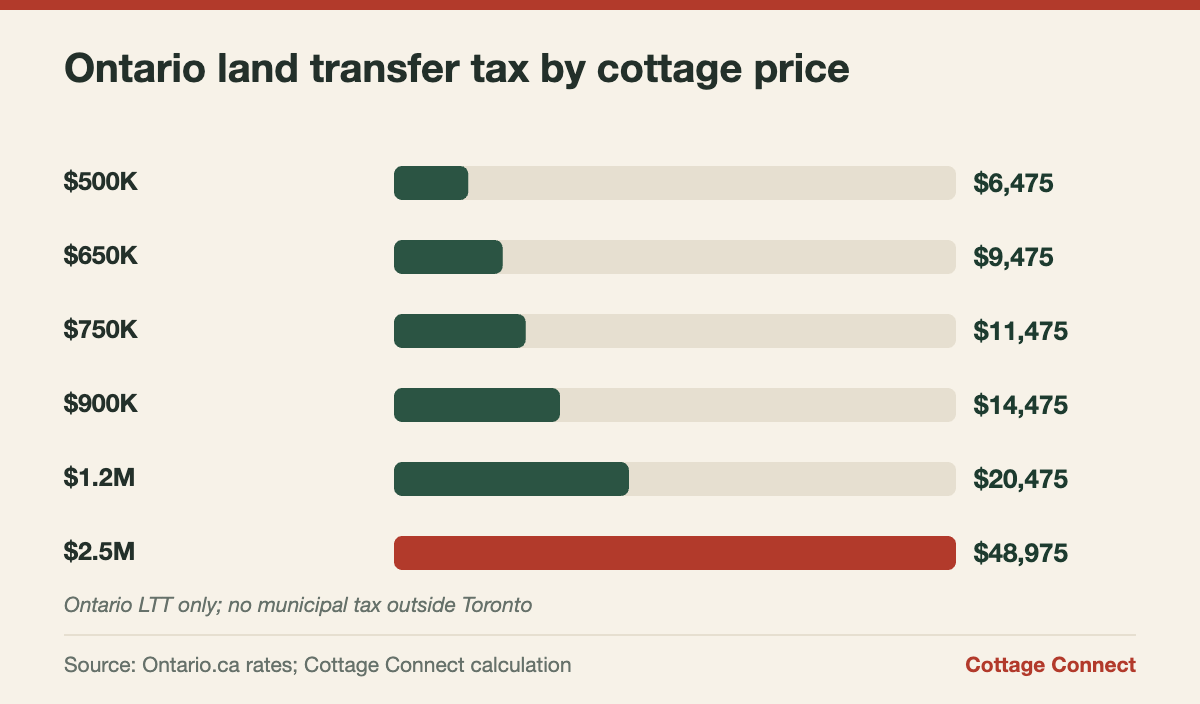
| $500,000 | $6,475 |
| $546,770 (Haliburton Q1 2026 average) | $7,410.40 |
| $650,000 | $9,475 |
| $722,839 (Muskoka Q1 2026 average) | $10,931.78 |
| $750,000 | $11,475 |
| $900,000 | $14,475 |
| $1,200,000 | $20,475 |
| $2,500,000 | $48,975 |
The regional averages come from RE/MAX’s 2026 Recreational Property Report, which we cover in Ontario cottage prices 2026 by region. To run your own figure, use our cottage buyer calculators.
Is there a first-time buyer refund on a cottage?
Usually not. Ontario’s refund is worth up to $4,000, which covers the tax on the first $368,000 of the price. To qualify, according to Ontario’s first-time buyer refund rules, you must:
- Be a Canadian citizen or permanent resident.
- Never have owned a home anywhere in the world, and neither can your spouse while they were your spouse.
- Occupy the home as your principal residence within 9 months of buying it.
- Apply within 18 months of the purchase, if the refund wasn’t claimed at registration.
Most cottage buyers already own a home, so they don’t qualify. The exception is a first-time buyer who moves to cottage country full-time, for example someone working remotely who buys a four-season home in the Kawarthas instead of a condo in the city. In that case, the refund would cut the tax on a $650,000 home from $9,475 to $5,475.
The 2.5% band on cottages over $2 million
The top Ontario rate applies only to land with one or two single-family residences, which includes most cottages. On a $2.5 million property on one of the big Muskoka lakes, the tax is $48,975. The last $500,000 alone costs $12,500.
If the same $2.5 million bought vacant land with no home on it, the top 2.5% rate wouldn’t apply and the tax would be $46,475. Few buyers will see that difference, but large waterfront lots do trade.
No Toronto tax, but watch for the NRST
Toronto’s municipal land transfer tax applies only to property inside the City of Toronto, so a cottage buyer pays the provincial tax alone. That’s a real saving compared with buying a home of the same price in the city, where both taxes apply.
Buyers who are foreign nationals, or corporations or trustees that count as foreign, also pay Ontario’s Non-Resident Speculation Tax. It has applied province-wide at 25% since October 25, 2022. On a $650,000 cottage, that is $162,500 on top of the $9,475 land transfer tax.
Other closing costs to budget for on a cottage
Land transfer tax is usually the biggest closing cost, but cottages have a few extras city buyers don’t see:
- Inspections. A septic inspection and water testing, on top of the home inspection.
- Survey and shoreline. Older cottage surveys may not show docks or decks on a shore road allowance, which your lawyer may need to deal with.
- Mortgage insurance tax. If your cottage mortgage is insured, Ontario’s 8% tax on the premium is due in cash. See cottage mortgage rules for 2026.
- Adjustments. You may reimburse the seller for prepaid property tax, propane or fuel oil left in the tank, and road association dues.
- Legal fees and title insurance. Cottage files can take longer if there are access agreements or rights of way to review.
Tip: When you compare a cottage with a second property in the city, add the land transfer tax to both. A $900,000 home in Toronto pays both provincial and municipal tax, while a $900,000 cottage in Muskoka pays only the provincial $14,475. On paper the cottage looks more expensive per square foot, but the closing costs are lower.
Frequently asked questions
Do you pay land transfer tax on a cottage in Ontario?
Yes. A cottage is taxed the same way as any other residential property in Ontario, using the provincial bands from 0.5% to 2.0%, plus 2.5% above $2 million for land with one or two single-family homes. On a $650,000 cottage the tax is $9,475, paid by the buyer on closing.
Is there Toronto land transfer tax on a cottage?
No. Toronto’s municipal land transfer tax only applies to property located inside the City of Toronto. A cottage in Muskoka, Haliburton, the Kawarthas or any other region pays only the Ontario land transfer tax, no matter where the buyer lives.
Can I get the first-time buyer refund on a cottage?
Only if the cottage becomes your principal residence within 9 months and you, and your spouse, have never owned a home anywhere. Most cottage buyers already own a home, so they don’t qualify. A first-time buyer moving to cottage country full-time could receive up to $4,000.
Who pays land transfer tax on a cottage, buyer or seller?
The buyer pays it. Your real estate lawyer collects the tax from you before closing and pays it when the transfer is registered electronically. It can’t be added to your mortgage, so it needs to be part of the cash you bring to closing, along with your down payment and legal fees.
Budget the full cost before you offer
Once you know your closing costs, browse cottages for sale with a firm all-in number, or read our cottage buyer’s guide for the full process.
This article is general information as of October 2026, not legal, tax, mortgage or financial advice. Rules and numbers change, so confirm the details for your situation with a licensed professional.