Cottage insurance in Ontario is priced and written differently from a city home policy. Insurers look closely at the heat source, distance from fire services, road access, how often the cottage sits empty and whether you rent it, and many expect you to inspect, maintain and winterize the place when you’re away. If there’s a wood stove, expect to need an inspection by a WETT-certified professional before you can get coverage.
Key takeaways
- Seasonal cottage policies are often limited to named perils such as fire, wind and smoke.
- Heating system, fire service access, road access and occupancy all drive the premium.
- Insurers commonly ask for a wood stove inspection by a WETT-certified professional.
- You must tell your insurer if you rent the cottage, and short-term rentals may need added coverage.
- Since January 1, 2026, Ontario’s Fire Code requires carbon monoxide alarms on every storey of homes with fuel-burning appliances, cottages included.
How cottage insurance differs from home insurance
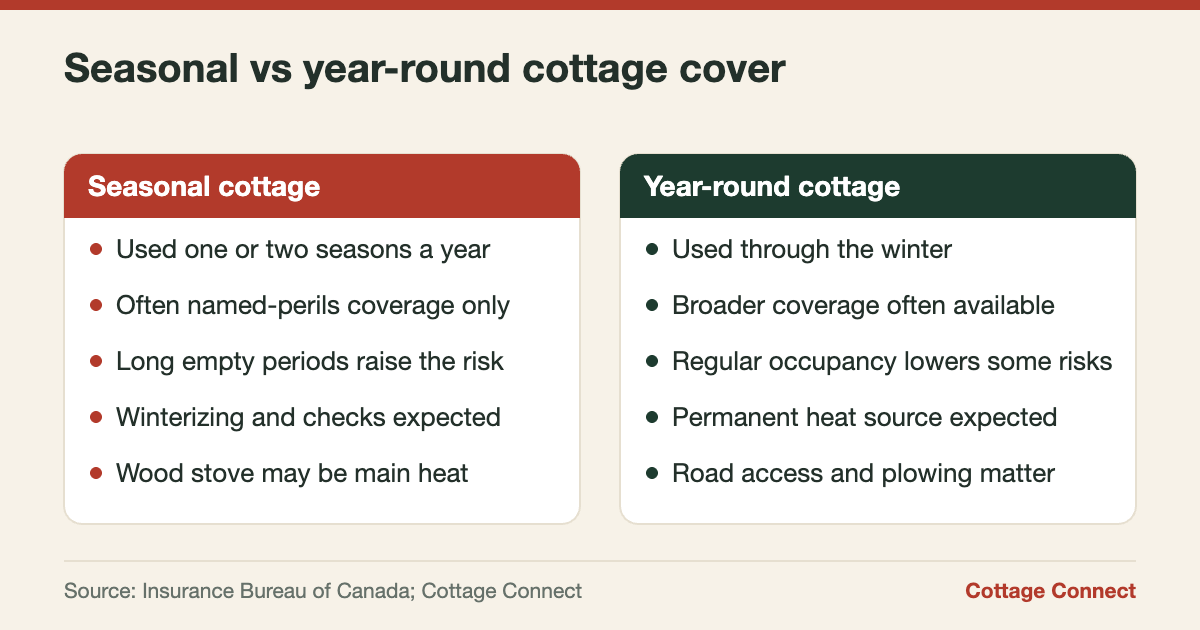
The Insurance Bureau of Canada describes seasonal properties as riskier than a primary home because they can sit unoccupied for long periods and are often far from emergency services. That changes what’s offered.
- Named perils. Coverage is often limited to listed perils such as fire, wind, smoke and explosion. Comprehensive coverage may not be available.
- Common exclusions. Poor maintenance, wear and tear, pests, theft and vandalism are often excluded.
- Optional add-ons. Sewer backup, certain water losses, watercraft and recreational equipment can often be added for a cost.
- Structure. You can add the cottage to your home policy or insure it separately.
Insurers also use the terms “seasonal” and “secondary” differently, so ask how your policy classifies the cottage. A cottage used every weekend in winter is a different risk from one closed from Thanksgiving to May.
What affects cottage insurance premiums
According to IBC, premiums reflect location, distance from emergency services, road access, construction type, age, condition, heating system, occupancy, security, maintenance, claims history and deductible. In cottage country, a few of those matter most.
| Factor | Why it matters at a cottage |
|---|---|
| Heating system | Fire is a common cause of cottage claims, so wood stoves and fireplaces get extra scrutiny. |
| Fire service access | Distance to a fire hall and hydrant, and whether trucks can reach the property in winter. |
| Road or water access | Water-access and seasonal-road cottages are harder to protect and to reach after a loss. |
| Occupancy | Long empty periods let small problems, such as a leak, become large ones. |
| Wiring | Older wiring, especially knob-and-tube, is a red flag for many insurers. |
| Rentals | Guests change the liability and damage risk. |
For a sense of scale, a 2021 MoneySense guide put typical annual cottage premiums at $800 to $3,000. Treat that as dated and get a quote for the actual property. Our annual cottage cost budget shows where insurance fits.
Wood stoves and WETT inspections
WETT (Wood Energy Technology Transfer) is the education and certification body for people who inspect and install wood-burning systems. According to WETT, every WETT inspection starts with a full visual inspection, the report must state the level of inspection done, and a WETT-certified professional doesn’t issue a “WETT certificate.” What your insurer wants is the inspection report.
For buyers, this matters on timing. If the cottage has a wood stove or fireplace, book the inspection during your conditional period. If it fails, you may need a new chimney liner, clearances or even a new stove before an insurer will cover it, and that’s a cost to negotiate before the deal is firm.
Leaving a cottage empty: vacancy and winter
IBC notes that coverage may be more limited when a property is left unoccupied for long periods, and that insurers often expect owners to inspect, maintain and winterize a seasonal property when it isn’t in use. Frozen pipes are among the losses that may not be covered.
Policies define vacancy and unoccupancy in their own wording, with their own time limits. Read yours, then:
- Winterize properly, or keep heat on with a monitored low-temperature alarm.
- Arrange regular checks by a neighbour or caretaker and keep a log of the visits.
- Clear snow from the roof if the building isn’t designed for heavy loads.
- Keep photos and receipts of the cottage and its contents somewhere other than the cottage.
Our checklist for closing the cottage for winter covers the practical jobs.
Insuring a cottage you rent out
Tell your insurer whether you rent the cottage, how often, and for how long. IBC says optional coverage may be available for short-term rentals. The 2021 MoneySense guide warned that failing to disclose rentals could result in the termination of your policy, and that heavy rental use may push you to a commercial insurer.
Rentals also need to comply with local bylaws. Our posts on short-term rental rules in cottage country and renting your cottage cover licensing and the practical side.
The 2026 carbon monoxide alarm rules
Amendments to the Ontario Fire Code that took effect on January 1, 2026 expanded carbon monoxide alarm requirements. In homes with a fuel-burning appliance, a fireplace or an attached garage, a CO alarm is now required beside each sleeping area and on every storey, including storeys without bedrooms. The City of Kawartha Lakes’ notice on the change says the rules apply to all residential occupancies, including cottages.
A cottage with a wood stove, propane fireplace or gas furnace needs to comply. Check every level, including a basement or loft, and treat a bunkie with a fuel-burning heater the same way.
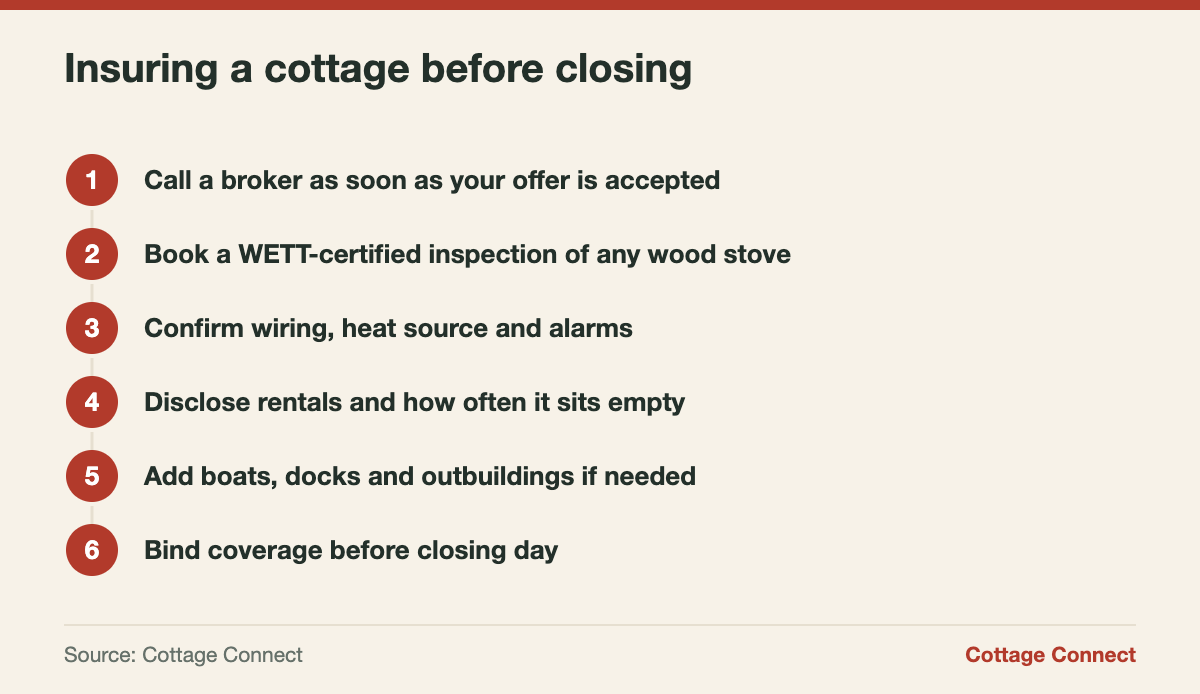
Tip: Call a broker the day your offer is accepted, not the week before closing. Cottage insurers can take time to quote, may want a WETT inspection report or photos of the electrical panel, and some won’t cover water-access or rental cottages at all. Your lender won’t release funds without proof of coverage.
Frequently asked questions
Do I need a WETT inspection to insure a cottage?
Often, yes. Many insurers ask for an inspection of any wood stove, fireplace or chimney by a WETT-certified professional before they’ll cover a cottage. The inspector provides a report stating the level of inspection done. Book it during your conditional period so any repairs can be priced before your offer is firm.
Is cottage insurance more expensive than home insurance?
It can be, relative to the value. Cottages are often far from fire halls, empty for long periods and heated with wood, and insurers price those risks. Seasonal policies may also offer narrower named-perils coverage. Quotes vary a lot by property, so get one on the specific cottage before you commit.
Does insurance cover a cottage left empty all winter?
Possibly, but with conditions. Insurers often expect seasonal properties to be winterized, inspected and maintained while unoccupied, and losses such as frozen pipes may not be covered if you don’t. Policies define vacancy differently, so read the wording and keep a log of your checks.
Do I need special insurance to rent my cottage?
You need to tell your insurer, and you may need added coverage. Optional short-term rental coverage is available from some insurers, and frequent renting can push you to a commercial policy. Failing to disclose rentals can put your coverage at risk, so ask before your first booking.
Shopping for a cottage?
Ask about the heat source, wiring and access on every listing you view. Start with cottages for sale across Ontario and use our cottage inspection checklist when you visit.
This article is general information as of October 2026, not legal, tax, mortgage or financial advice. Rules and numbers change, so confirm the details for your situation with a licensed professional.