Free well water testing in Ontario is available for anyone whose drinking water comes from a private well or other private system, including a cottage that treats lake water. Public Health Ontario labs test the sample for E. coli and total coliform bacteria at no charge. You pick up a sterile bottle from your local health unit, take the sample correctly and get it to a drop-off location within 48 hours.
Key takeaways
- Bacteria testing for private drinking water, including treated lake water, is free through Public Health Ontario labs.
- Use only the lab’s sterile bottle, and get the sample to the lab within 48 hours, kept cool.
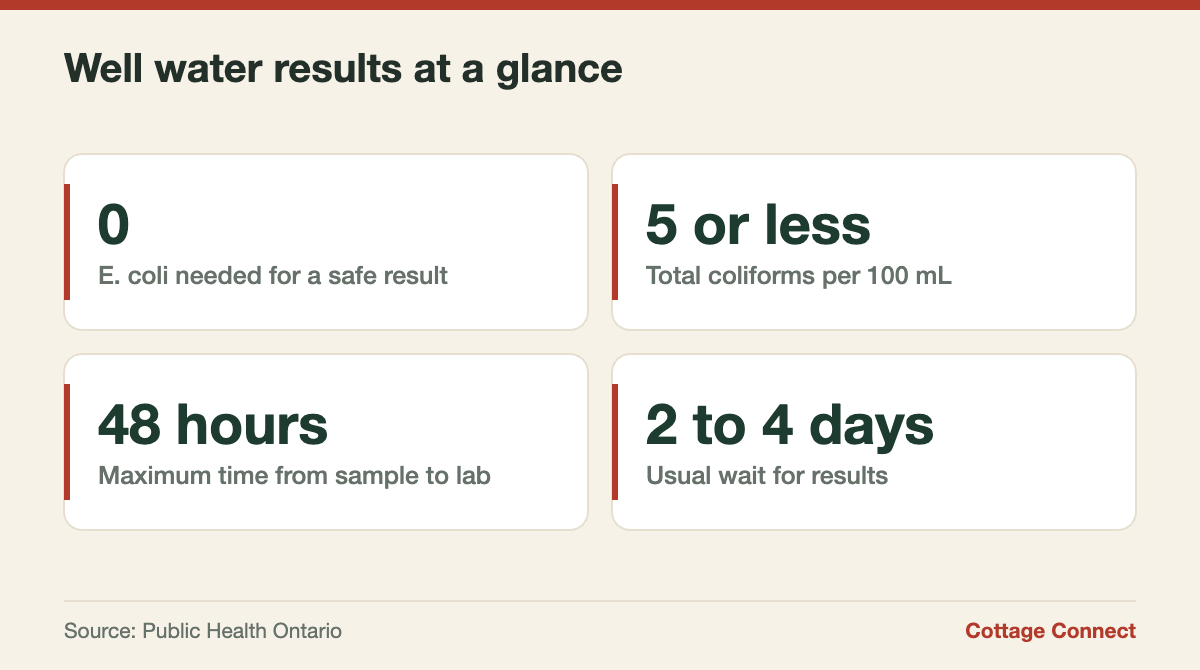
- A safe result means 0 E. coli and 5 or fewer total coliforms per 100 mL.
- The free test covers bacteria only; chemistry such as metals or nitrates needs a private lab.
- Drop-off is weekdays only, and some locations don’t accept samples on Fridays, so plan around your cottage weekends.
Who can get free well water testing in Ontario?
Public Health Ontario’s well water testing service is for people who rely on a private drinking water source, such as a well, a cistern or treated lake water. Local health units describe the bacteria test as free. Lakelands Public Health, for example, says the service covers private wells serving a single home or cottage and recommends testing at least twice a year.
The program has been questioned before. A proposed phase-out in 2023 and 2024 didn’t go ahead, and the minister said testing would continue. For now, the bottles and the lab analysis cost nothing.
How to take a well water sample
Most failed tests that turn out to be false alarms come from a contaminated sample, not a contaminated well. Public Health Ontario’s instructions are specific:
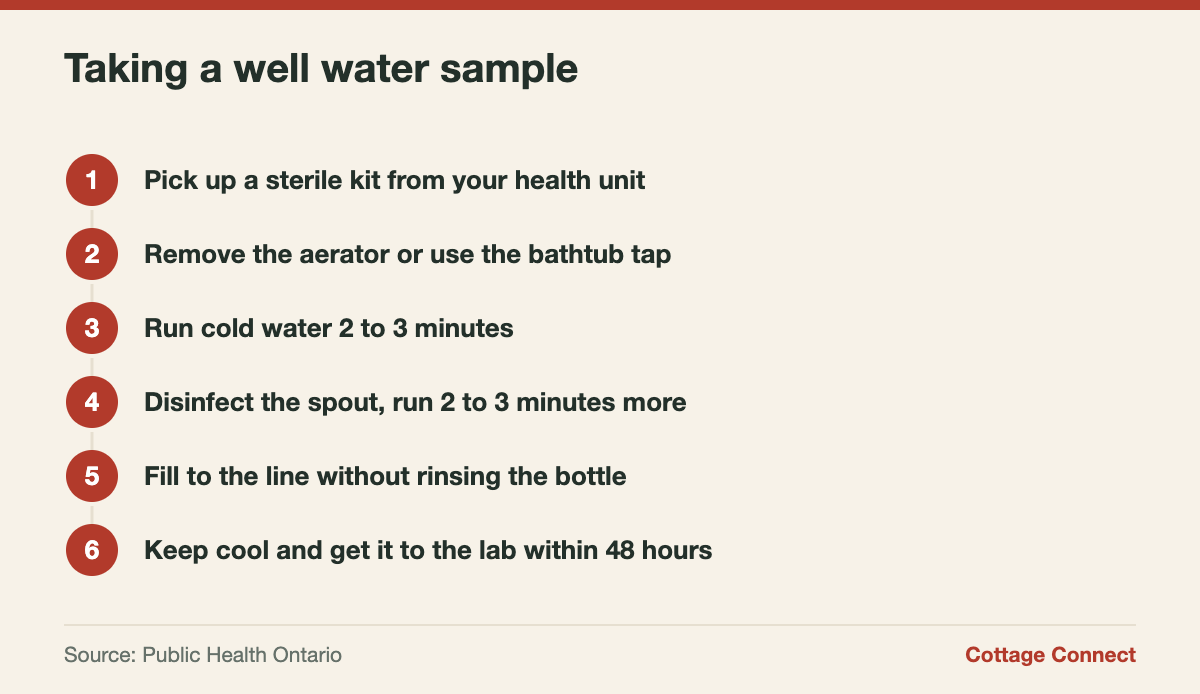
- Pick up a sealed kit from a PHO lab, your public health unit or a designated pickup location. Use only that bottle, and check the seal isn’t broken.
- Sample from an inside tap. Remove the aerator if you can; if not, use a tap without one, such as the bathtub. Don’t use an outside faucet or a hose.
- Run the cold water for two to three minutes.
- Disinfect the spout with an alcohol swab or a diluted bleach solution (1 part bleach to 10 parts water), then run the water for another two to three minutes.
- Fill the bottle to the marked line. Don’t rinse it, because it contains a preservative, and don’t touch the inside of the lid or set the lid down.
- Keep the sample cool but not frozen, and fill in the form with the property address.
The 48-hour rule and weekday drop-offs
This is where cottage owners get caught. Samples must be tested within 48 hours of collection, and lab and drop-off locations aren’t open on weekends or statutory holidays. A sample taken on Saturday morning and carried home to Toronto on Sunday will usually be too old by the time a lab can process it.
Drop-off rules also vary by health unit. The Simcoe Muskoka District Health Unit asks people to drop off samples the same day they collect them, Monday to Thursday before 4:30 p.m., with no Friday drop-offs. Its locations include Gravenhurst, Huntsville, Midland, Barrie, Collingwood and Cookstown.
The practical answer is to sample on a weekday morning and drop the bottle off on your way out of cottage country. Check your own health unit’s hours before you go.
How to read your well water results
Results usually come within two to four business days through Public Health Ontario’s online Water Testing Portal, using the barcode on your bottle, or by phone. Results are reported per 100 mL of water.
| Result | What it means | What to do |
|---|---|---|
| 0 E. coli and 5 or fewer total coliforms | No significant evidence of bacterial contamination | Keep testing regularly |
| 0 E. coli and more than 5 total coliforms | Significant bacterial contamination | Stop drinking it, call your health unit, disinfect and resample |
| 1 or more E. coli | Fecal contamination; unsafe to drink | Stop drinking it, call your health unit, disinfect and resample |
| Overgrown (NDOGN or NDOGT) | Too many other bacteria to read the sample; treat as unsafe | Stop drinking it and resample |
Coliforms without E. coli often point to surface water getting into the well, for example through a cracked casing, a loose cap or poor grading around the wellhead.
What to do if the well fails
According to the health unit guidance:
- Stop using the water for drinking or food preparation. Use bottled water, or boil it for at least one full minute.
- Disinfect the well and the plumbing, using Public Health Ontario’s well disinfection guidance or a licensed well contractor.
- Wait at least 48 hours after disinfection before retesting.
- Two safe results taken one to three weeks apart usually confirm the disinfection worked.
- If results don’t improve, have the well and any treatment system professionally inspected.
When cottage owners should test
Testing at least twice a year is the common recommendation. At a cottage, the most useful times are:
- After opening in spring, once the system has been flushed.
- After heavy rain, flooding or a spring melt that puts surface water near the well.
- After any repair to the well, pump, pressure tank or treatment system.
- Before closing in fall, so you have a baseline for next year. Our post on closing the cottage for winter covers the rest of the shutdown.
- Before you buy, as a condition of your offer.
Lake water and chemical testing
The free test only looks for bacteria. Public Health Ontario doesn’t test for chemicals or minerals, so for things like arsenic, uranium, nitrates or hardness, you’ll need a private licensed laboratory, at your own cost.
If the cottage draws from the lake, the free test is useful for checking that the treatment system is working, so take the sample after treatment, at the kitchen tap. Untreated lake water is a different question; our explainer on how lake water quality is measured covers what lake reports can and can’t tell you.
Tip: If you’re buying a cottage, make your offer conditional on a satisfactory water test and do the sampling yourself or with your inspector, not the seller. Note who took the sample and when, and if the water has been shut off for the season, ask for a re-opening visit so the test can be done properly.
Frequently asked questions
Is well water testing free in Ontario?
Bacteria testing is. Public Health Ontario labs test private drinking water for E. coli and total coliforms at no charge, using sterile bottles available from local health units. Testing for chemicals, metals or minerals isn’t included and needs to be done through a private licensed lab, which charges for the analysis.
How long does it take to get well water results?
Usually two to four business days after the lab receives the sample. You can check online through Public Health Ontario’s Water Testing Portal with the barcode from your bottle and your last name, or by phone. Paper reports are mailed if they aren’t picked up.
Can you drink lake water at a cottage?
Not untreated. Lake water can carry bacteria and other contaminants, so it needs a proper treatment system, such as filtration with UV, before drinking. Public Health Ontario accepts treated lake water samples for free bacteria testing, which is a good way to confirm the system is working. Test regularly, especially after storms.
Looking at cottages with a well?
Read our guide to septic systems, wells and water, then browse cottages for sale and ask for past water test results on every property you like.
This article is general information as of October 2026, not legal, tax, mortgage or financial advice. Rules and numbers change, so confirm the details for your situation with a licensed professional.