Buying a cottage in the fall can work in your favour: fewer buyers are looking, and some sellers would rather not carry the place through another winter. The risk is that snow, ice and shut-off water lines hide the septic bed, the dock, the shoreline and the roof, which are the items that cost the most to fix. If you buy between mid-October and April, inspect what you can now and write the offer to cover what you can’t.
Key takeaways
- Fall and winter buyers often face less competition, and several Ontario cottage markets were rated buyer’s markets in 2026.
- Once snow falls, a septic leaching bed, dock cribs and the shoreline can’t be properly assessed.
- Test the well for bacteria before the water is shut off. The test is free in Ontario.
- Check whether the road is maintained in winter. Some townships stop plowing certain roads from October 15.
- Use conditions, records and, where both sides agree, a lawyer-drafted holdback to cover what you can’t see.
Is fall a good time to buy a cottage in Ontario?
For many buyers, yes. Spring and summer bring the most listings and the most competition. By October, the families who wanted a cottage for this summer have bought or given up, and the sellers still on the market are often more willing to talk.
The 2026 numbers point the same way. RE/MAX’s 2026 Recreational Property Report rated Haliburton and Orillia as buyer’s markets, with Muskoka, the Kawarthas and Peterborough balanced. Royal LePage’s 2026 report found that 66% of its Ontario agents were seeing properties take longer to sell. Longer days on market usually mean more room to negotiate on price, closing date and what stays with the cottage.
The trade-off is information. A cottage viewed in July shows you how it works when people are using it. A cottage viewed in January shows you a closed building on a frozen lake. Our regional pages, such as cottages in Haliburton, are a good place to compare where inventory is sitting longest.
What you can’t properly inspect once the snow comes
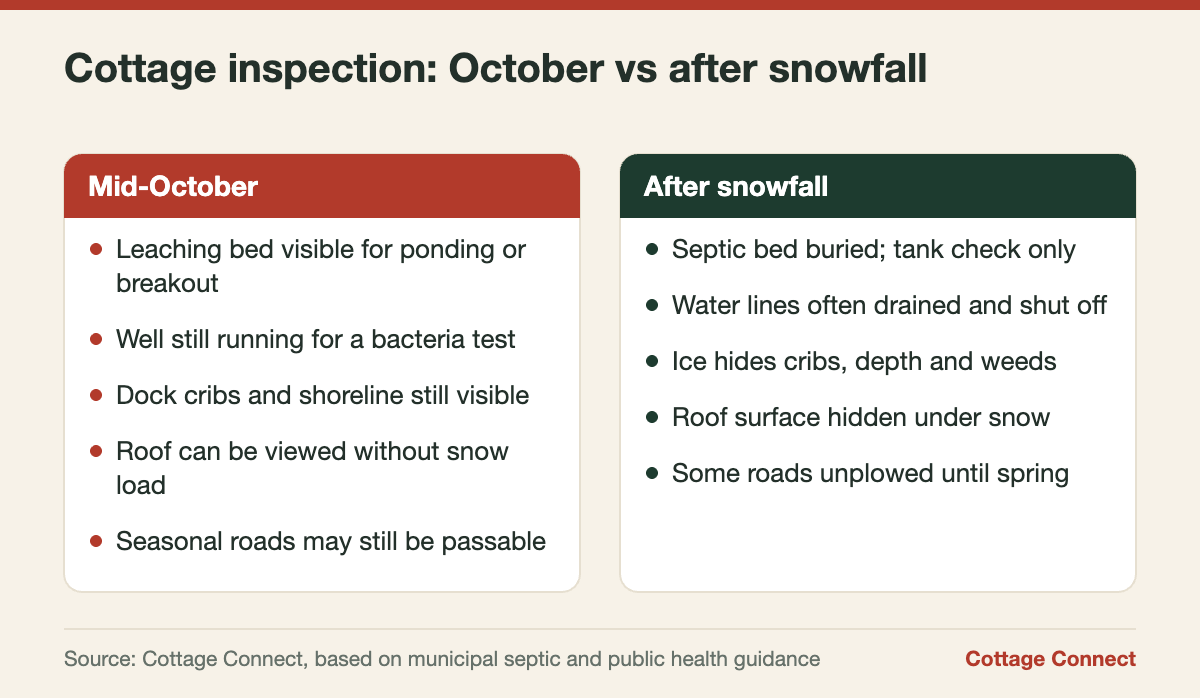
A home inspector can still look at the structure, electrical panel, heating and interior in winter. What suffers is everything outside and underground. Here is how the main items change between now and February.
| Item | Mid-October | After snowfall | Workaround |
|---|---|---|---|
| Septic leaching bed | Visible: look for ponding, odour, soggy or unusually green grass | Buried; only the tank can be opened, if it can be found | Permit records, pump-out history, spring holdback |
| Well and plumbing | Water usually still on; flow and bacteria can be tested | Often drained and shut off for winter | Test now, or negotiate a de-winterize and re-winterize visit |
| Dock, cribs and shoreline | Mostly visible from shore or by boat | Under ice and snow | Ask for photos, permits and repair invoices |
| Water depth and weeds | Can be checked from the dock | Not possible | Ask neighbours, the lake association or the seller |
| Roof and drainage | Roof surface and grading visible | Hidden under snow | Drone or photo records, age of roof in writing |
For the full list of what to look at, see our cottage inspection checklist. The point here is timing: several of those items are only checkable for a few more weeks.
Septic inspections in cold weather
The septic system is the single most important thing to check, and the hardest in winter. Ontario treats septic systems under 10,000 litres a day as part of the Building Code, and the Town of Huntsville’s septic guidance notes that a system must meet the full standard even when the cottage is only used seasonally.
Municipal inspection programs are a useful clue to the season. Muskoka Lakes runs its septic inspections generally from May to October, and Algonquin Highlands schedules its 2026 inspections between June 1 and October 31. Inspectors want the lids exposed and the bed visible, and private inspectors face the same limits once the ground freezes.
What you can still do in winter
- Ask the township for the septic permit and any inspection records on file.
- Ask the seller for pump-out receipts. Huntsville recommends pumping at least every five years for a typical household.
- Have the tank pumped and inspected if the lids can be reached safely. This confirms the tank’s condition, though not the bed’s.
- Note the system’s age. Huntsville asks for records or a third-party inspection on systems over 25 years old.
Our guide to septic systems, wells and water explains what the different system types mean for a buyer.
Test the well before the water is shut off
Many seasonal cottages are drained and closed around Thanksgiving. If the cottage you like still has water on, ask to take a bacteria sample now. Testing for E. coli and total coliforms is free for private wells serving a single home or cottage through Public Health Ontario labs. Kits come from local health units, and samples must reach the lab within 48 hours, kept cool.
A clean bacteria result is not the whole story. Chemical testing (for example, for metals or nitrates) is not free and goes through a private lab. If the cottage draws and treats lake water, ask what treatment is installed and when it was last serviced.
If the owner has already closed up, ask for past test results. Our post on closing the cottage for winter explains what draining and winterizing involves, which helps you judge what a re-opening visit will cost.
Seasonal roads and winter access
A road you drove in October may not be open in January. In The Archipelago on Georgian Bay, for example, certain roads are not maintained from October 15 to May 15, and private plowing of them is prohibited. Other townships have their own lists of seasonal roads, and private roads depend on whoever maintains them.
This matters for more than convenience. Access affects insurance, emergency services and financing. Sagen’s vacation home program, for example, separates year-round homes with year-round road access from seasonal properties, which can need a larger down payment. Our comparison of road access and water access cottages covers the trade-offs in more detail.
How to protect your offer
There is no cooling-off period on a resale cottage in Ontario. Once the deal is firm, you own the risks you didn’t check. A fall or winter offer should be written with that in mind.
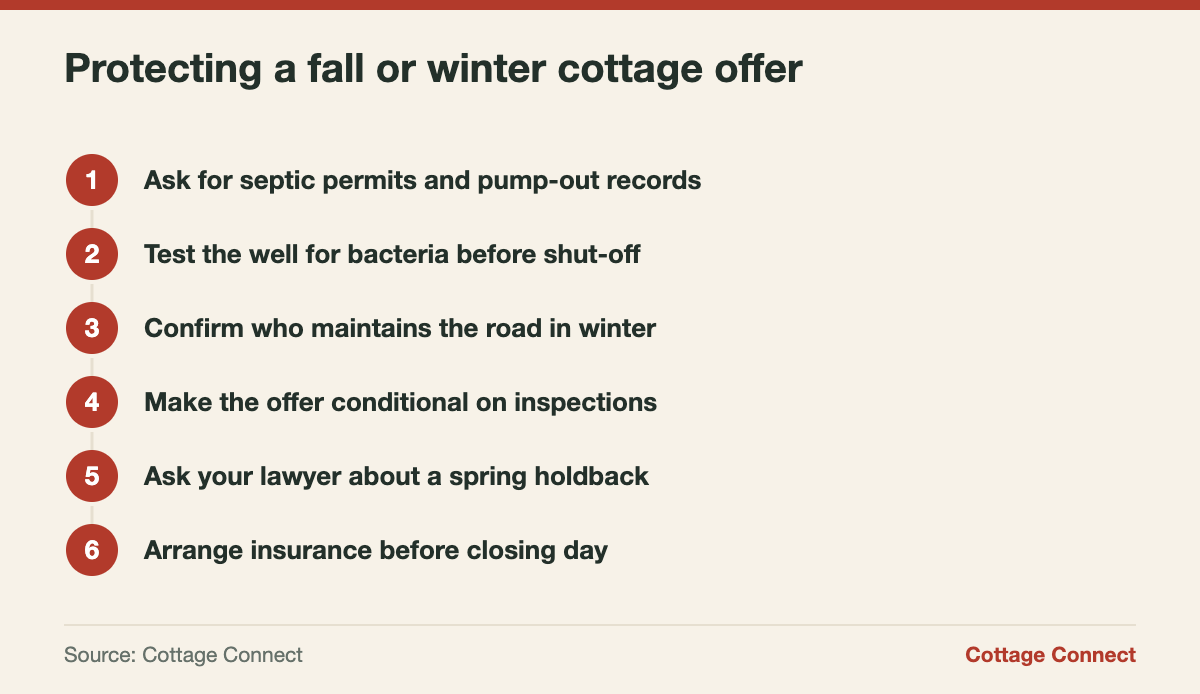
- Make the offer conditional on a home inspection, a septic inspection, water potability and financing, with enough days to book specialists who work up north.
- Request records: septic permit, pump-outs, well records, water test results, dock and shoreline permits, hydro and heating bills.
- Ask for access to the water: either test before shut-off or have the seller agree to a de-winterize visit and pay to close it up again.
- Discuss a holdback with your lawyer. Some buyers and sellers agree to hold part of the price in trust until a spring septic or dock inspection. It only works if both sides agree and the terms are drafted carefully.
- Arrange insurance before closing. Insurers ask about heating, road access and occupancy, and a wood stove may need its own inspection.
Tip: Before you book a showing in November, ask the listing agent three questions: is the water still on, are the septic lids accessible, and is the road plowed. The answers tell you which inspections you can do now and which ones need a clause in your offer.
Frequently asked questions
Can you inspect a septic system in winter?
Partly. An inspector can usually pump and examine the tank if the lids can be reached, but a buried, frozen leaching bed can’t be assessed for ponding, breakout or soft ground. In winter, rely more on permit records, pump-out receipts and the system’s age, and consider a holdback tied to a spring inspection.
Is it cheaper to buy a cottage in the winter?
Not automatically, but negotiating power often improves. Fewer buyers are active, and listings that sat through summer may have motivated sellers. In 2026, several Ontario cottage markets, including Haliburton and Orillia, were rated buyer’s markets. Price still depends on the lake, frontage and condition, not the calendar.
Should I buy a cottage I’ve only seen under snow?
You can, but only with extra protection. Ask for summer photos, records for the septic, well and dock, and a clear answer on winter road access. Write conditions that give you time to get specialists in, and talk to your lawyer about a holdback or seller warranties for anything that can’t be checked.
Does a seasonal cottage cost more to finance?
Often it needs more money down. Lenders and mortgage insurers prefer four-season homes with year-round road access. Under Sagen’s vacation home program, a seasonal property is limited to 90% loan-to-value, while a winterized home on a maintained road can qualify with less down. Lender policies vary, so get pre-approved for the specific property type.
Looking at cottages this fall?
Start with cottages for sale across Ontario, filter by region, and book showings while the water is still running and the ground is still bare.
This article is general information as of October 2026, not legal, tax, mortgage or financial advice. Rules and numbers change, so confirm the details for your situation with a licensed professional.