Buying a cottage on a private road is common in Ontario, but it means the owners, not the township, pay to grade, plow and insure the road. Before you buy, confirm that you have a legal right to use every part of the road, find out who maintains it and what it costs, and check how it affects your mortgage, insurance and future building permits. Ontario’s Road Access Act gives some protection against an access road being closed, but it doesn’t give you ownership.
Key takeaways
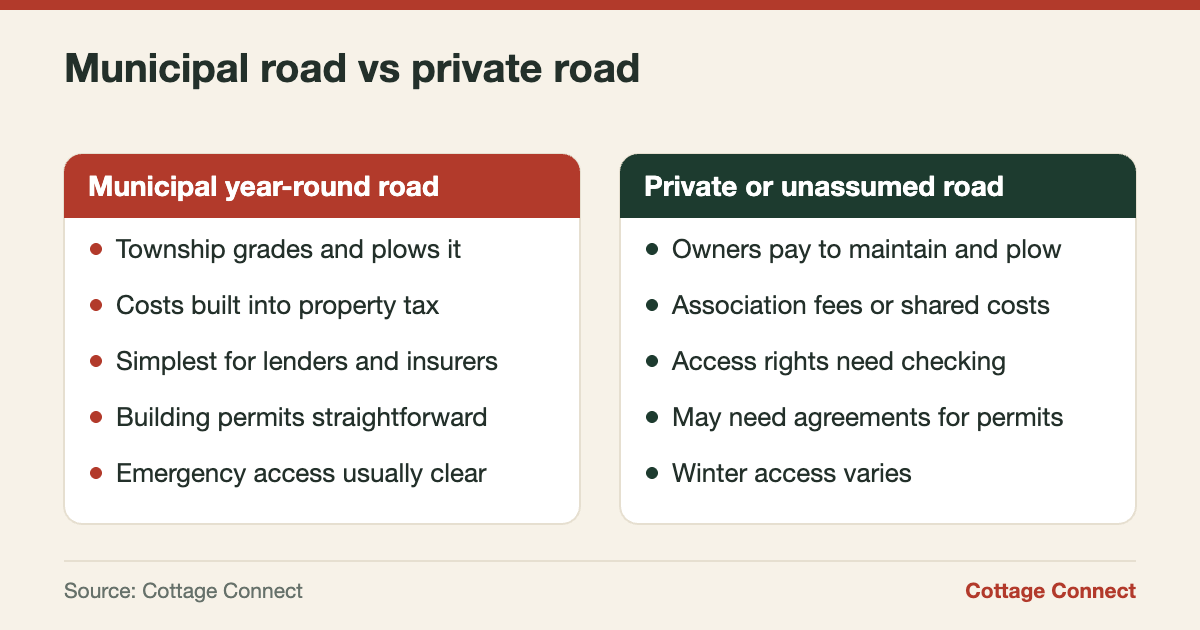
- A private road shifts maintenance, plowing, insurance and liability to the people who use it.
- Confirm a registered right of way or other legal access over every property the road crosses.
- The Road Access Act generally stops an owner closing an access road without a court order, but it isn’t a right of ownership.
- Some townships require road access agreements before issuing building or septic permits.
- Lenders and insurers ask about year-round access, so a private road can change your down payment and premium.
What counts as a private road?
“Private road” covers several different situations, and each carries different risks.
| Type | Who owns it | Who maintains it | What to check |
|---|---|---|---|
| Private lane over neighbours’ land | The landowners it crosses | Users, by agreement or habit | Registered rights of way for each section |
| Association-owned road | A road association or corporation | The association | Fees, bylaws, reserves, insurance |
| Unassumed municipal road | The township | Property owners | Road access agreement and insurance rules |
| Seasonal municipal road | The township | Township, part of the year | Winter maintenance dates and plowing rules |
Tay Valley Township in Lanark County is a good example of the third type. Its FAQ on private unassumed roads explains that the township became the owner of some subdivision roads when the plans were registered, but the owners along them are responsible for maintenance, and the township has no legal obligation to upgrade or assume them.
Do you have legal access?
Using a road for years isn’t the same as having a right to use it. Your lawyer should confirm that there is a registered right of way, or other legal access, over every property the road crosses between the public road and your lot. Gaps in the chain are more common on older cottage roads than buyers expect.
What the Road Access Act does
Ontario’s Road Access Act protects access roads, meaning non-public roads that are the only motor vehicle route to one or more properties. As Toronto real estate lawyer Bob Aaron explained in a column on cottage road access, the Act generally prevents a landowner from closing such a road without a court order. It doesn’t give users ownership, and its protection may not apply where another usable road exists.
His column described a case on Lake St. John in Ramara Township, where a new owner of the land under a cottage road raised the seasonal fee from $500 to $2,000 and closed the road when cottagers refused to pay. The courts sided with the cottagers. That’s reassuring, but it took litigation, which is exactly what a buyer wants to avoid.
Road associations, fees and liability
On many private roads, owners form an association that collects fees, hires a contractor and buys liability insurance. Ask for the association’s bylaws, budget, reserve balance, insurance certificate and recent minutes. Large repairs, such as culverts or a washout, are often funded by special levies.
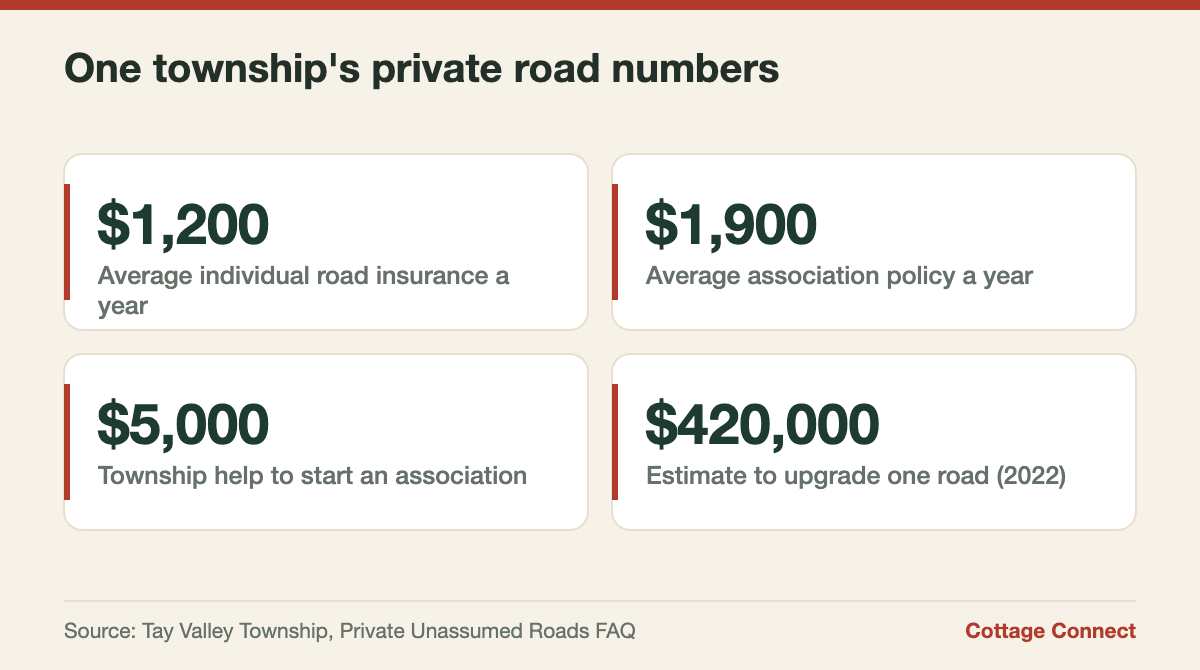
Tay Valley’s FAQ shows how the costs and risks play out:
- Individual road insurance averages $1,200 a year, while association policies average $1,900, including directors’ liability.
- Owners who pay for maintenance can be liable for claims, and owners who don’t join an association may not be covered by its insurance.
- The township offers up to $5,000 to help establish an association and up to $500 a year toward insurance.
- Upgrading one gravel road so the township might assume it was estimated at $420,000 in April 2022.
Add the fees to your carrying costs. Our annual cottage cost budget has a line for them.
Winter access and emergency services
Ask who plows the road, under what contract, and how far in. Some municipal roads are seasonal too: in The Archipelago, certain roads aren’t maintained from October 15 to May 15, and private plowing of them is prohibited. Check whether a fire truck or ambulance can actually reach the cottage, especially past narrow bridges or steep hills. Tay Valley’s minimum standards for these roads exist precisely so emergency vehicles can get through.
If you’re viewing in the fall, our post on buying a cottage in fall or winter covers what to check before the snow.
How a private road affects financing and insurance
Lenders and mortgage insurers care about access. Under Sagen’s vacation home program, a four-season Type A property needs year-round access on a public road maintained by the municipality, or a privately serviced road with a maintenance contract. A property without that can still qualify as a seasonal Type B home, but with at least 10% down. Our post on cottage mortgage rules for 2026 has the numbers.
Insurers also price road access, along with distance from emergency services. Get a quote before you firm up; see cottage insurance in Ontario.
Building permits on a private road
Don’t assume you can add a bunkie or replace the septic system. Tay Valley’s zoning historically prohibited building or septic permits for lots without frontage on an improved street. Permits are now possible where a road access agreement is in place, and the township says any building or septic permit requires one, including for wood stoves and solar panels. Ask your township how it handles permits on private roads before you plan renovations.
Questions to ask before you buy
- Is the road public, private, unassumed or seasonal, and who owns each section?
- Is there a registered right of way for every section between the public road and the lot?
- Is there a road association, and is membership required by agreement or by title?
- What are the annual fees, the reserve balance and any planned special levies?
- Who plows it, under what contract, and how far?
- Does the township require a road access agreement for permits?
- Has there ever been a dispute about using the road?
Tip: Drive the road after a heavy rain and, if you can, after a snowfall. Washouts, steep grades and soft spots tell you more about future road costs than the association’s budget, and talking to a neighbour you meet on the way often tells you more than the listing.
Frequently asked questions
Who maintains a private road in Ontario?
The people who use it, not the township. Owners usually share the cost through a road association or informal agreement, paying for grading, plowing, culverts and insurance. On unassumed municipal roads, the township may own the land but still leave maintenance to residents, as Tay Valley Township does.
Can a neighbour block my cottage access road?
Not easily. Ontario’s Road Access Act generally prevents an owner from closing an access road that is the only motor vehicle route to other properties without a court order. It doesn’t give users ownership, and it may not protect you if another usable road exists. A registered right of way is far stronger protection.
Can I get a mortgage on a cottage on a private road?
Usually, yes, but the terms may change. Sagen’s program treats a privately serviced road with a maintenance contract as acceptable year-round access for a four-season cottage. Without that, the property may be treated as seasonal, which means at least 10% down under the program, and some lenders set stricter rules.
Compare road and water access
Read our comparison of road access and water access cottages, then browse cottages for sale, including in Lanark County, home to Tay Valley Township and its private road rules.
This article is general information as of October 2026, not legal, tax, mortgage or financial advice. Rules and numbers change, so confirm the details for your situation with a licensed professional.