Dock permits in Ontario can come from up to four places: the province, for structures touching more than 15 square metres of Crown land or nearby shore lands; Parks Canada, for any in-water work on the Trent-Severn Waterway or Rideau Canal; your township, which may require a building permit; and federal agencies for fish habitat and navigation. A floating dock under the size limit on an ordinary lake may need nothing, while a crib dock on the Trent-Severn needs several approvals.
Key takeaways
- A provincial work permit may be needed for structures in contact with more than 15 m² of Crown land or nearby shore lands.
- Floating structures aren’t considered in physical contact with the shore lands under the provincial rules.
- On the Trent-Severn and Rideau, every in-water structure, including seasonal docks and repairs, needs a Parks Canada permit.
- Townships set their own building permit rules for cribs, boathouses and structural repairs.
- A permit from one agency doesn’t replace another, so check each layer.
Who owns the lake bed under your dock?
On most Ontario lakes, your deed stops at the shoreline or at a shore road allowance, and the bed of the lake belongs to the Crown. That’s why a dock built from your waterfront can still need provincial approval: part of it sits on public land.
Some lots don’t even reach the water. If there’s an original shore road allowance between your lot and the lake, your dock may start on municipal land. Our explainer on what a shore road allowance is covers how that works.
Provincial work permits and the 15 square metre rule
Ontario’s guidance on Crown land and shore land work permits (updated September 25, 2026) sets out the main test:
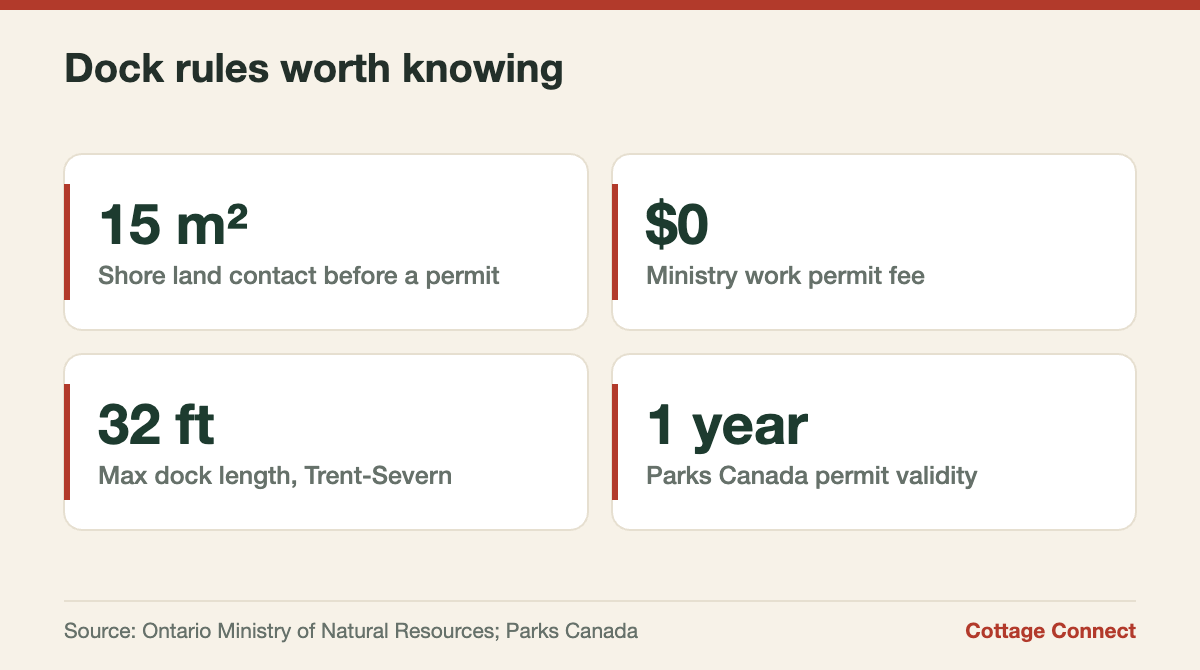
- A structure in physical contact with more than 15 m² of Crown land or nearby shore lands may need a work permit.
- Structures touching 15 m² or less generally don’t, if you meet the conditions in Ontario Regulation 239/13.
- A floating structure over shore lands isn’t considered in physical contact with them, which often helps floating docks.
- Removing a dock or boathouse doesn’t need a permit, provided no dredging is involved and the conditions are met.
- New erosion control structures, and dredging or filling, may need a permit. Repairs to existing erosion control can be exempt but must be registered first.
The ministry reviews applications and issues permits free of charge, though you pay for any studies required. Applications go through the Natural Resources Information Portal, and review doesn’t start until the file is complete. In the Lake Simcoe watershed outside the conservation authority’s area, a permit is required for all of these activities.
Docks on the Trent-Severn Waterway and Rideau Canal
Parks Canada manages the bed and waters of both waterways, and its rules are stricter. According to Parks Canada’s in-water and shoreline works permit page:
- Any work on, under or over the bed and waters needs a permit, including installing, repairing, replacing, relocating or removing docks, boathouses, boatports, swim rafts and boat lifts.
- Seasonal and temporary docks need a permit too, and no in-water structures are grandfathered.
- The maximum dock length is 32 feet, with extensions possible for site conditions.
- Road-access properties may have one dock; water-access-only properties may have two.
- Treated wood can’t be in contact with the water, and creosote isn’t approved.
- Permits are valid for one year, and work can be paused during fish spawning windows.
Parks Canada suggests applying several months before you want to start. This applies to the Kawartha lakes on the system, such as Sturgeon Lake and Balsam Lake, and to lakes along the Rideau Canal.
Township building permits for docks and boathouses
Municipal rules vary widely, so check your own township. Two examples show the range:
- Muskoka Lakes. The township’s dock permit requirements say any new crib area needs a building permit, as do repairs to stringers or cribs above or below the waterline. Replacing decking only doesn’t. Cribs and stringers must be sized by a professional engineer or a designer with a structural BCIN, and a provincial permit or authorization has to be submitted with the building permit application.
- Dysart et al (Haliburton). The municipality’s building FAQ lists floating or pole docks among the projects exempt from building permits.
Boathouses are a step further. Muskoka Lakes notes that two-storey boathouses, and single-storey boathouses with living space or non-boat uses, still need occupational authority from the province, with a fee.
| Project | Provincial (most lakes) | Parks Canada (Trent-Severn, Rideau) | Township |
|---|---|---|---|
| Floating dock | Generally not in contact with shore lands | Permit required | Often exempt; check |
| Crib dock over 15 m² contact | Work permit may be needed | Permit required | Building permit often required |
| Replacing deck boards only | Usually not | Permit required for repairs | Muskoka Lakes: no permit |
| Two-storey boathouse | Occupational authority needed | Permit required | Building permit required |
Fish habitat, navigation and conservation authorities
Two federal programs can apply. Fisheries and Oceans Canada reviews projects in or near water that could harm fish habitat, and an authorization is needed if impacts can’t be avoided. Transport Canada’s navigation protection program requires notice and approval before construction on waters listed in the federal schedule. Your local conservation authority may also regulate work near the shoreline, and its permit doesn’t replace the provincial one.
How to get a dock or boathouse approved
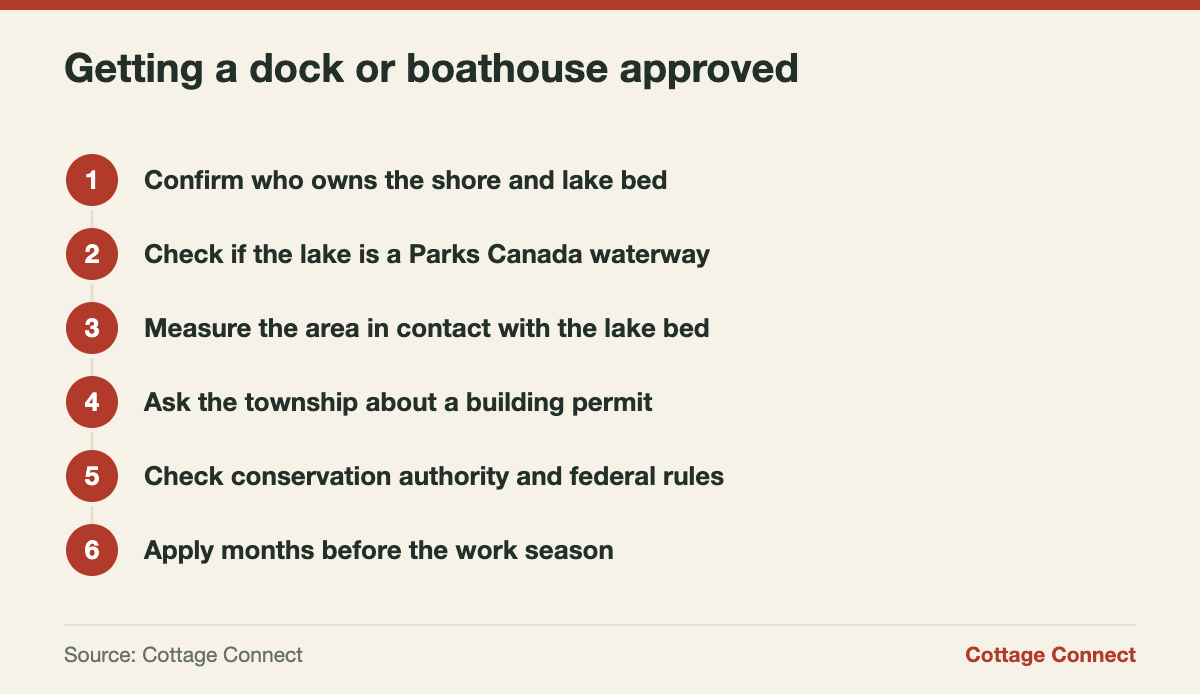
- Confirm where your lot ends: shoreline, high water mark or shore road allowance.
- Check whether the lake is part of the Trent-Severn or Rideau system.
- Measure the area of cribs or posts in contact with the lake bed.
- Call the township building department about permits and design requirements.
- Check conservation authority, fish habitat and navigation requirements.
- Apply in winter for summer work, and keep every approval for when you sell.
Tip: Before you buy a waterfront cottage, ask for the permits behind the dock and boathouse, not just their age. An unpermitted crib dock on Crown land or the Trent-Severn can become your problem the day you close, and replacing it later means meeting today’s rules, which may allow less than what’s there now.
Frequently asked questions
Do I need a permit for a floating dock in Ontario?
On most lakes, a floating dock isn’t considered in physical contact with the shore lands, so it often doesn’t need a provincial work permit, and some townships exempt it from building permits. On the Trent-Severn Waterway and Rideau Canal, every dock, including floating and seasonal ones, needs a Parks Canada permit.
Do I need a permit to repair my dock?
It depends on the repair and the location. In Muskoka Lakes, replacing deck boards doesn’t need a building permit, but repairs to cribs or stringers do. On the Trent-Severn and Rideau, Parks Canada requires a permit for repairs to in-water structures. Always check before structural work.
How long can a dock be on the Trent-Severn Waterway?
Parks Canada’s policy sets a maximum dock length of 32 feet, though extensions may be granted for site conditions. Road-access properties may have one dock and water-access-only properties two. Treated wood can’t touch the water, and a permit is valid for one year from issue.
Shopping for waterfront?
Start with our waterfront buying basics and browse by lake on our lakes directory to see which ones fall under Parks Canada rules.
This article is general information as of October 2026, not legal, tax, mortgage or financial advice. Rules and numbers change, so confirm the details for your situation with a licensed professional.