Cottage rental income is taxable, and it’s reported on Form T776 with your personal return. You can deduct a reasonable share of the cottage’s costs, such as property tax, insurance, utilities and mortgage interest, based on how much of the year it was rented rather than used by your family. But for short-term rentals that don’t comply with provincial or municipal rules, the CRA denies all expenses for the non-compliant period, so the gross rent becomes taxable.
Key takeaways
- Report cottage rental income on Form T776; extra services such as meals can make it business income on T2125.
- Shared costs must be split between rental and personal use on a reasonable basis, such as days.
- Since 2024, all expenses are denied for any period a short-term rental breaks provincial or municipal rules.
- Capital cost allowance can’t create or increase a rental loss, and it’s recaptured when you sell.
- Heavy renting can weaken a principal residence claim on the cottage.
How cottage rental income is reported
According to the CRA’s guidance on accommodation sharing, rental income is generally reported on Form T776, Statement of Real Estate Rentals, with the net amount carried to your return. If you provide extra services beyond the accommodation, such as meals, cleaning during the stay or guided activities, the income may be business income reported on Form T2125 instead.
Rent paid through a booking platform counts the same as rent paid by cheque. Report the gross rent and deduct the platform’s fees as an expense. If the cottage is owned jointly, each owner reports their share.
Splitting costs between rental and personal use
Most cottages are a mix: rented for some weeks, used by the family for others. Costs that only exist because of the rental, such as cleaning between guests, platform fees and rental advertising, are fully deductible. Costs that apply to the whole year, such as property tax, insurance, hydro, internet and mortgage interest, have to be split on a reasonable basis. A common method is the share of rental days in the total days the cottage was used.
Worked example
Say you rent the cottage for 10 weeks (70 nights) at $3,000 a week, and your family uses it for 35 nights. Rental use is 70 out of 105 days, or two-thirds.
| Item | Annual amount | Deductible |
|---|---|---|
| Gross rent | $30,000 | |
| Property tax, insurance, hydro, internet, repairs, mortgage interest | $31,000 | $20,666.67 (two-thirds) |
| Cleaning between guests | $2,000 | $2,000 |
| Platform fees | $900 | $900 |
| Net rental income | $6,433.33 |
The figures are an illustration. Your accountant may use a different allocation method if it’s more reasonable for how the cottage is used, but be consistent from year to year. Our annual cottage cost budget shows where these expenses come from.
The short-term rental expense denial rule
This is the change most cottage owners haven’t caught up with. For rentals of less than 90 consecutive days, the CRA now denies all expenses for any period in which the rental doesn’t comply with provincial or municipal rules, for example where the township requires a licence and you don’t have one, or where short-term rentals aren’t permitted at all. The CRA’s tax tip on the change says it applies to expenses incurred after 2023, with relief for 2024 only for rentals that became compliant by December 31, 2024.
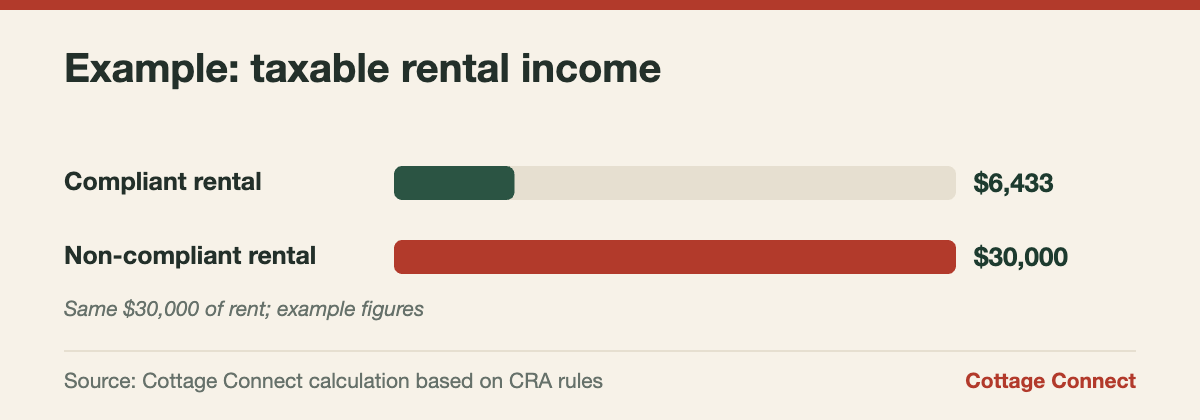
In the example above, the same $30,000 of rent from a non-compliant rental would produce $30,000 of taxable income, not $6,433.33. That’s $23,566.67 of lost deductions. At an illustrative 40% marginal tax rate, it costs about $9,427 more in tax, before any fines from the township.
Licensing has spread quickly across cottage country, with caps and waiting periods in some areas. Check our summary of short-term rental rules in Ontario cottage country, and confirm with your township before the first booking, not after.
Capital cost allowance and rental losses
You can claim capital cost allowance (CCA), the tax version of depreciation, on the rental share of the building and on furniture or equipment used for the rental. Two cautions:
- No losses from CCA. CCA on rental property can’t be used to create or increase a rental loss.
- Recapture. When you sell, CCA you’ve claimed on the building can be added back to income. It can also complicate a principal residence claim on the cottage.
Many cottage owners who rent a few weeks a year choose not to claim CCA on the building for these reasons. That’s a decision to make with an accountant.
How renting affects the principal residence exemption
A cottage can be designated as your principal residence for years your family ordinarily inhabits it. The CRA notes that where the main purpose of a property is earning income, it may not be considered ordinarily inhabited. Renting for a few summer weeks while your family uses it the rest of the season is very different from renting it every week of the year. We cover the designation rules in capital gains on a cottage.
Other rules that come with rental income
- HST. Short-term accommodation is taxable for GST/HST purposes, and once your taxable revenue passes $30,000 over four calendar quarters, you generally have to register.
- Insurance. Tell your insurer you’re renting, or you may not be covered. See cottage insurance in Ontario.
- Family rentals. Renting to relatives at below-market rent is usually not treated as a commercial rental, and deductions may be limited. Ask before you claim.
How to keep your rental records
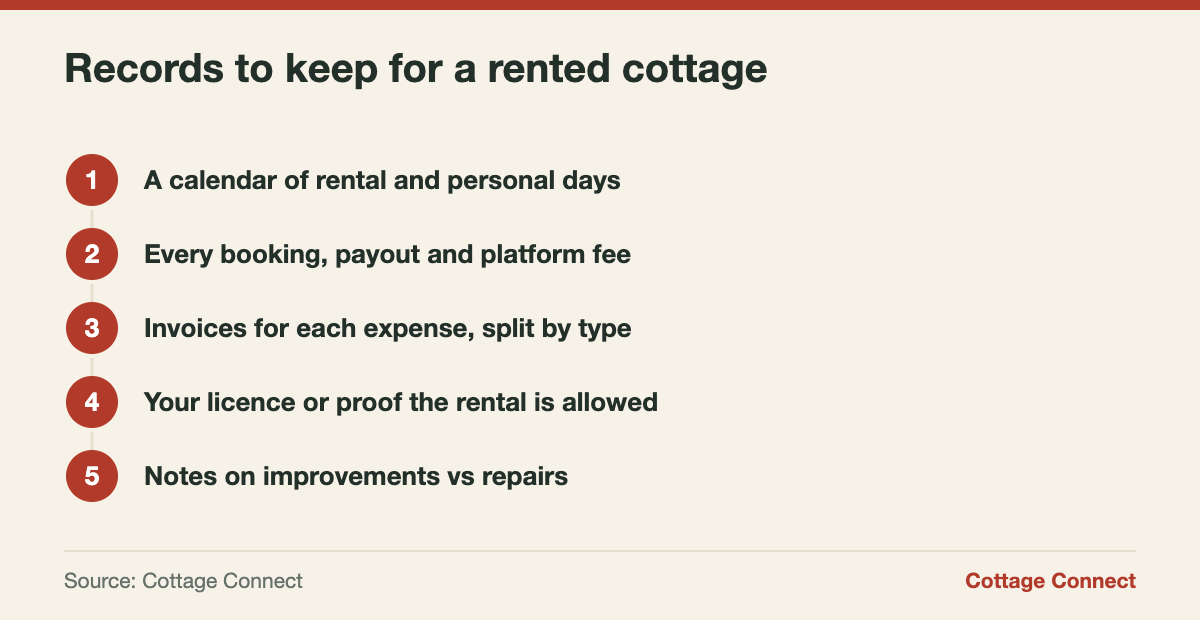
- Keep a calendar of every rental night and every family night, updated as you go.
- Save every booking confirmation and payout statement from each platform.
- File invoices by type: fully rental, shared, or personal.
- Keep a copy of your licence, or the township’s confirmation that no licence is needed.
- Separate capital improvements (new roof, septic, dock) from repairs.
Tip: Before you list the cottage on a booking site, email the township and ask, in writing, whether a licence or registration is needed for short-term rentals at your address. Keep the reply. If a licence is needed, the date it’s issued is the date your expenses start counting, so get it before your first guest arrives.
Frequently asked questions
Do I have to report cottage rental income?
Yes. Rent from your cottage is taxable income, whether it’s paid through a platform, by e-transfer or in cash. Report it on Form T776 with your personal return and deduct the eligible share of expenses. If you provide services such as meals or daily cleaning during stays, it may be business income on Form T2125.
Can I deduct mortgage interest on a cottage I rent out?
You can deduct the rental share of interest on money borrowed to buy or improve the cottage. If the cottage is rented two-thirds of the days it’s used, two-thirds of the interest is generally deductible. If the rental doesn’t comply with local short-term rental rules, none of it is deductible for the non-compliant period.
What if my township doesn’t require a short-term rental licence?
Then the rental may already be compliant, but check the rest of the rules: zoning, occupancy limits, septic approvals and any provincial requirements. Get confirmation from the township in writing and keep it with your tax records. Rules are changing quickly in cottage country, so check again each year.
Thinking about renting your cottage?
Start with our guide to renting your cottage, then check the licensing rules in any area you’re considering, including Muskoka, where licence caps and waiting periods apply, before you buy with rental income in mind.
This article is general information as of October 2026, not legal, tax, mortgage or financial advice. Rules and numbers change, so confirm the details for your situation with a licensed professional.