You don’t always need 20% down for a cottage. A winterized, four-season cottage on a maintained road can qualify for an insured mortgage with 5% of the first $500,000 and 10% of the rest through Sagen’s second-home program, if your lender offers it. Seasonal cottages need at least 10% under that program, and many water-access properties end up at 20% or more. With the Bank of Canada announcing its next rate decision on October 28, it pays to know your numbers before you write an offer.
Key takeaways
- CMHC stopped insuring second homes in 2015, so insured cottage mortgages go through private insurers such as Sagen.
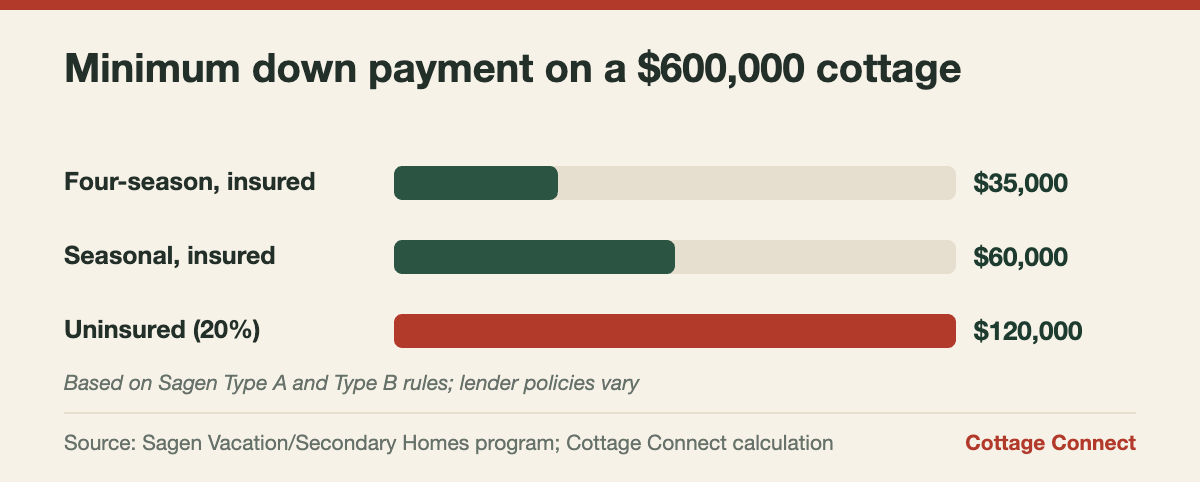
- On a $600,000 four-season cottage, the minimum insured down payment is $35,000; a seasonal one needs $60,000.
- Insurance premiums run 4.00% to 4.35% of the loan at those levels, and Ontario adds 8% sales tax on the premium, payable in cash.
- You qualify at the higher of your rate plus 2% or 5.25%, with your principal home’s costs counted too.
- Fixed rates have been rising with bond yields; the October 28 decision mainly affects variable and prime-based borrowing.
How much down payment do you need for a cottage?
It depends on the property more than on you. Mortgage insurers sort recreational properties into types, and the type sets the minimum down payment. Sagen’s Vacation/Secondary Homes program is the clearest published example.
| Property type | What it means | Minimum down | Down on $600,000 |
|---|---|---|---|
| Type A (secondary home) | Year-round use, permanent heat, year-round road access, drinkable water | 5% of first $500,000 plus 10% above | $35,000 |
| Type B (vacation home) | Seasonal use allowed, wood stove acceptable, seasonal or boat access acceptable | 10% (90% maximum loan-to-value) | $60,000 |
| Uninsured | Any property the lender will accept | 20% | $120,000 |
Two limits apply under Sagen’s rules. Above 80% loan-to-value, the property must be under $1.5 million, and the program excludes rental-pool, investment and timeshare properties. Not every lender offers these programs, and some lenders set their own stricter rules for cottages, so ask before you assume.
Four-season or seasonal: what lenders look for
The labels used in listings don’t always match how a lender or insurer sees the property. For a Type A cottage, Sagen looks for:
- A permanent heat source and a winterized building.
- Year-round access on a public road maintained by the municipality, or a private road with a maintenance contract.
- Drinkable water from a well, municipal supply or cistern, or lake water with its own treatment system.
A Type B cottage can have a seasonal road, boat-only access, a wood stove as its only heat and water that isn’t drinkable, as long as it has running water. That is why the same $600,000 price can mean very different cash requirements. Our guide to seasonal vs four-season cottages covers the practical differences, and the road question is covered in buying a cottage in fall or winter.
What mortgage insurance costs on a cottage
The insurance premium is added to the loan, but Ontario’s 8% sales tax on the premium must be paid in cash at closing. Using Sagen’s published premiums on a $600,000 purchase:
- Type A, minimum down ($35,000): loan of $565,000 at about 94% loan-to-value. A 4.00% premium is $22,600, plus $1,808 in sales tax. Total mortgage: $587,600.
- Type B, minimum down ($60,000): loan of $540,000 at 90%. A 4.35% premium is $23,490, plus $1,879.20 in sales tax. Total mortgage: $563,490.
- 20% down ($120,000): loan of $480,000 with no premium.
Sagen adds 0.20% for amortizations over 25 years, which are limited to first-time buyers or new construction at high loan-to-value. Most cottage buyers will be on 25 years or less.
Qualifying for a cottage mortgage while you own a home
Lenders test you at the minimum qualifying rate: the greater of your contract rate plus 2% or 5.25%. Insured borrowers face the same test, with debt ratios capped at 39% (housing costs) and 44% (all debts) of gross income. Your Toronto mortgage, property tax and heating count against those ratios along with the cottage.
Here is what the test looks like on a 25-year amortization, assuming a 4.59% insured rate and a 5.09% uninsured rate (mid-October 2026 Ontario figures from Nesto):
| Scenario | Mortgage | Monthly payment | Payment at qualifying rate |
|---|---|---|---|
| Type A, $35,000 down | $587,600 | $3,281.67 at 4.59% | $3,968.00 at 6.59% |
| Type B, $60,000 down | $563,490 | $3,147.02 at 4.59% | $3,805.18 at 6.59% |
| 20% down | $480,000 | $2,816.35 at 5.09% | $3,388.71 at 7.09% |
Insured rates on second homes vary by lender, so treat these as illustrations. Run your own numbers with our cottage buyer calculators.
Cottage mortgage rates and the October 28 Bank of Canada decision
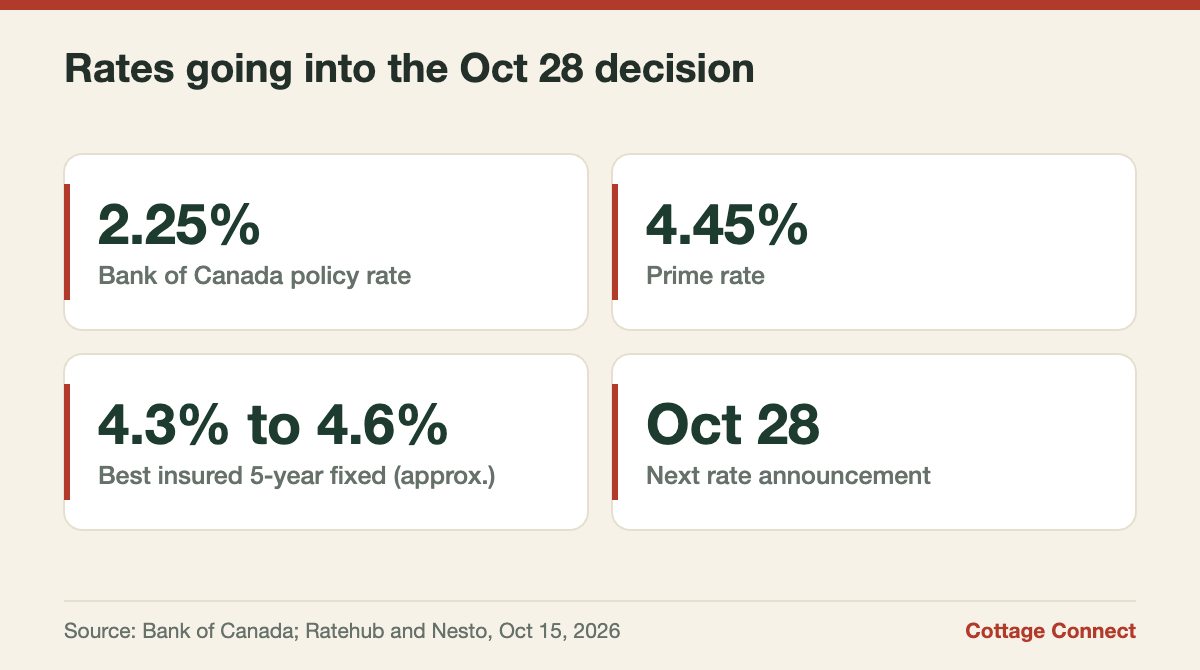
The Bank of Canada’s policy rate has been 2.25% since October 2025, and prime has been 4.45%. The Bank held again on September 2 and said upside risks to inflation had increased. Its next announcements are October 28 and December 9. Some analysts have said a hike is possible at one of them. Nobody knows which way it goes, so plan for both.
Variable and lines of credit
These move with prime. Best discounted 5-year variable rates were about 3.40% to 3.45% in mid-October. On a $480,000 mortgage over 25 years, a quarter-point increase from 3.45% to 3.70% would raise the payment from about $2,383.85 to $2,447.45 a month, or $63.60.
Fixed rates
Fixed rates follow bond yields rather than the Bank’s rate directly. The 5-year Government of Canada yield hit a 52-week high on September 28, and all six big banks raised fixed rates between September and mid-October. Best discounted 5-year fixed rates were roughly 4.3% to 4.6% insured, with uninsured rates higher. If you are shopping, a rate hold from a pre-approval can protect you while you look.
Tip: Get pre-approved for the property type, not just a price. Tell the lender whether the cottage is winterized, how it’s heated, whether the road is plowed and where the water comes from. A pre-approval written for a four-season home won’t help you if the cottage you fall in love with turns out to be seasonal.
Other ways buyers fund a cottage
- Equity in your principal home. A home equity line of credit can cover the down payment or the whole purchase, though it’s usually prime-based, so it moves with the Bank’s decisions.
- Buying with family. Pooling down payments can work, but get a written co-ownership agreement first. See our post on cottage co-ownership with family.
- Specialty lenders. Water-access and island cottages are harder to finance, and buyers often need 20% or more from lenders who accept them.
Frequently asked questions
Can you buy a cottage with 5% down in Ontario?
Yes, in some cases. Sagen’s second-home program allows 5% on the first $500,000 and 10% above that for a four-season cottage with permanent heat, year-round road access and drinkable water. The price must be under $1.5 million, and your lender has to offer the program. Seasonal cottages need at least 10%.
Does CMHC insure cottage mortgages?
No. CMHC stopped insuring second homes in 2015. Insured cottage mortgages now come through private insurers, with Sagen publishing a dedicated vacation and secondary home program. If the cottage will become your principal residence, standard owner-occupied insurance rules apply instead, so tell your lender how you plan to use it.
Can I use my FHSA or RRSP Home Buyers’ Plan for a cottage?
Both programs are designed for a home you will live in as your principal residence, so a weekend cottage generally doesn’t qualify. If you plan to move to the cottage full-time, read the CRA’s conditions for each program, or ask your accountant, before you sign anything.
Will mortgage rates drop after October 28?
There’s no way to know. The Bank of Canada has held at 2.25% all year and flagged rising inflation risks, and some analysts think a hike is possible. Fixed rates have already risen with bond yields. If you are buying soon, get a rate hold and budget for the qualifying rate, not the advertised one.
Ready to run the numbers?
Read our guide to financing a cottage, then browse cottages for sale with your real budget in hand.
This article is general information as of October 2026, not legal, tax, mortgage or financial advice. Rules and numbers change, so confirm the details for your situation with a licensed professional.