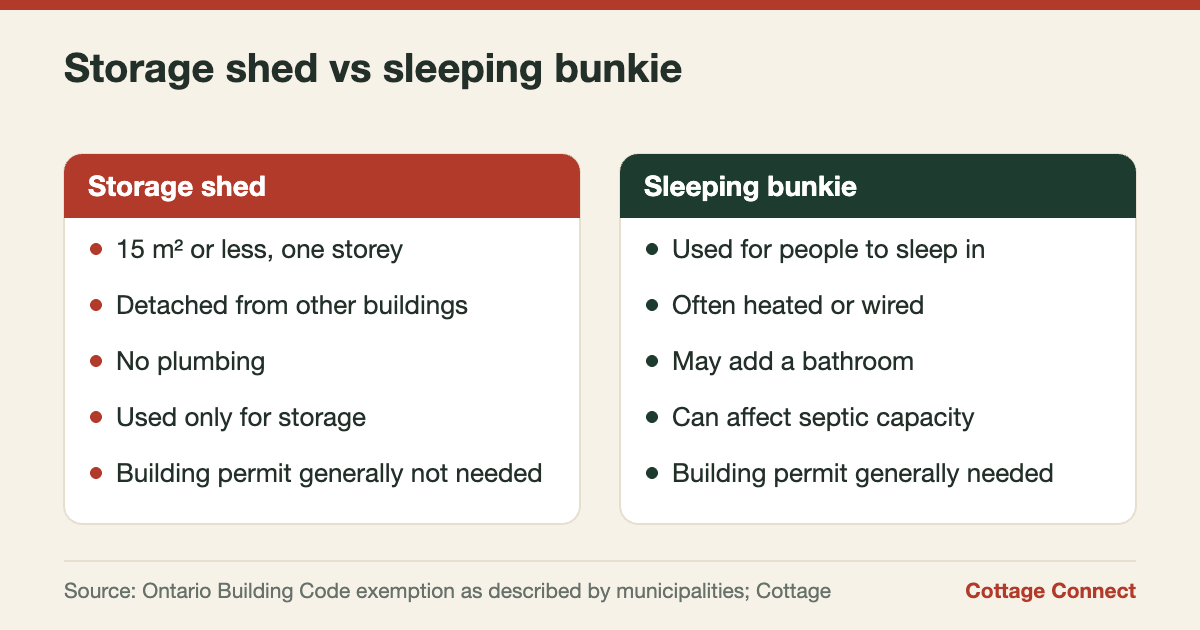
In most cases, yes. Ontario’s Building Code lets you skip a permit for a small detached building of 15 square metres or less only if it’s one storey, has no plumbing and is used for storage, so a bunkie that people sleep in generally needs a building permit regardless of size. Your township’s zoning bylaw, septic approval rules and shoreline setbacks also apply, and they often matter more than the permit itself.
Key takeaways
- The Building Code permit exemption covers storage sheds up to 15 m², not sleeping cabins.
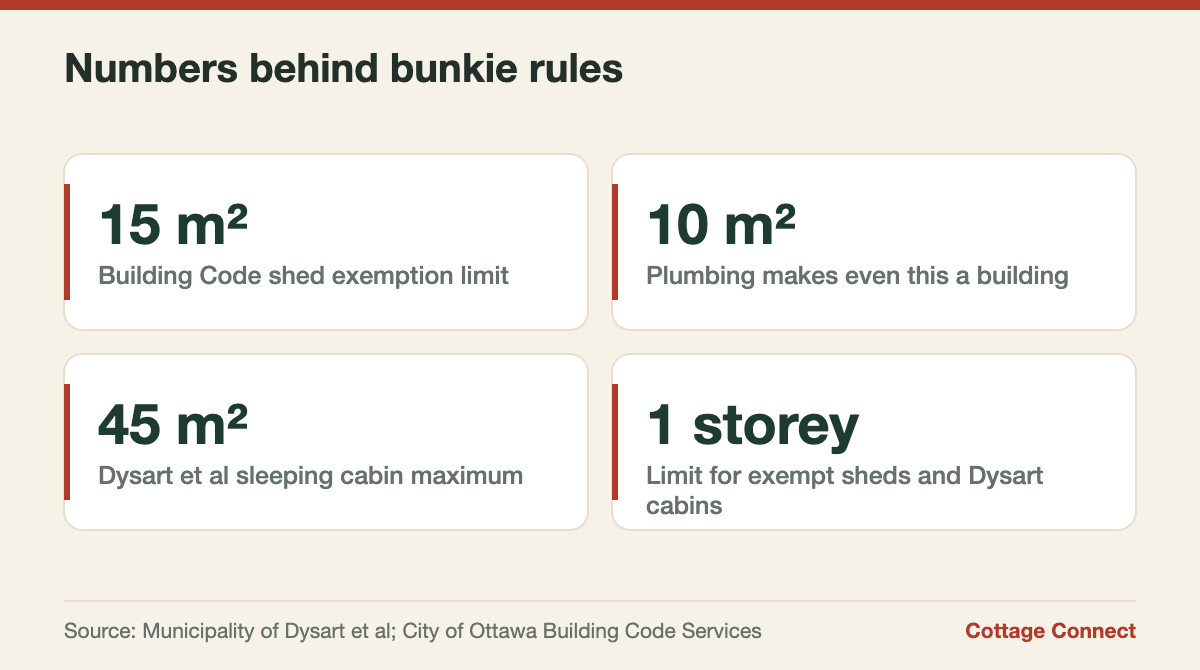
- Any structure with plumbing counts as a building even at 10 m² or less.
- Zoning sets where a sleeping cabin is allowed, how big it can be and whether it can have a bathroom.
- Adding a sleeping cabin can require septic approval before a building permit is issued.
- A heated bunkie with a fuel-burning appliance needs carbon monoxide protection under the 2026 Fire Code changes.
The 15 square metre rule and why it rarely covers a bunkie
The Ontario Building Code exempts certain small sheds from the permit requirement. As described in the City of Ottawa’s December 2025 advisory, the provincial exemption applies to a shed that is 15 m² or less, one storey, not attached to any other building, without plumbing, and used only for storage.
A bunkie fails the last test as soon as someone sleeps in it. Most also have wiring, many have heat, and some have a toilet or sink, each of which moves them further from the exemption. The Building Code Act also treats a structure of 10 m² or less that contains plumbing as a building, so even a tiny washroom hut isn’t exempt.
Why you’ll see different answers online
Some municipalities interpret the exemption more broadly. Ottawa’s advisory, for example, extends it to other low-rise residential accessory structures such as gazebos and pergolas, as long as they’re for personal use, 15 m² or less, one storey, unheated and without plumbing. That’s Ottawa’s policy, not a province-wide rule, and it still excludes heated buildings. Ask your own building department rather than relying on a contractor’s website.
What about a kit or a prefab bunkie?
Kits are sold in sizes that fit under 15 m² because of the shed exemption, which is why many buyers assume no permit is needed. The size may fit, but the use doesn’t. If the kit is going to have beds in it, treat it as a building that needs approval and get the drawings from the supplier before you order.
Zoning: where a sleeping cabin is allowed
Even where a building permit is straightforward, zoning decides whether you can have a sleeping cabin at all. The Municipality of Dysart et al in Haliburton is a useful example. Its building FAQ says:
- The maximum floor area of a sleeping cabin is 45 m² (485 sq ft), including covered decks and verandas.
- Sleeping cabins are limited to one storey.
- A bathroom is permitted, conditional on septic approval.
- A kitchen is not permitted.
- A cabin is allowed only where the zoning permits it, subject to septic approval.
Other townships set different limits, and some don’t allow sleeping cabins in certain zones. A bunkie with a kitchen and bathroom starts to look like a second dwelling, which most waterfront zones restrict.
| Feature | Typical effect on approvals |
|---|---|
| Storage only, 15 m² or less, no plumbing | Building permit generally not needed; zoning still applies |
| Used for sleeping | Building permit generally needed; must be allowed by zoning |
| Heat or a fuel-burning appliance | Outside Ottawa-style exemptions; carbon monoxide alarm rules apply |
| Toilet, sink or shower | Building permit and septic review |
| Kitchen | Often not permitted in a sleeping cabin |
Septic approval: the hidden step
A bunkie adds sleeping space, and septic systems are sized partly on bedrooms. Dysart’s FAQ says septic approval is required before a building permit if you’re constructing a new building, adding a bedroom, sleeping cabin or washroom, increasing fixture units, or increasing total floor area by 15% or more.
This matters again if you rent. Dysart’s septic review information for short-term rentals says a property must comply with its approved bedroom count. A bunkie that pushes you over the approved number can complicate a rental licence. More townships are also inspecting existing systems; see septic re-inspection programs in cottage country.
Shoreline setbacks and conservation authorities
Bunkies are often built close to the water, where the rules are tightest. Zoning bylaws set minimum setbacks from the high water mark, and Dysart notes that the high water mark is usually taken as the line where land-based vegetation ends, with a surveyor recommended if you’re unsure. Setbacks are measured to the closest outside wall.
If the lot is in an area regulated by a conservation authority, you may need its permit too. And if there’s a shore road allowance between your lot and the lake, the land closest to the water may not be yours to build on at all. Our post on shore road allowances explains.
Safety rules for heated bunkies
Since January 1, 2026, Ontario’s Fire Code requires carbon monoxide alarms on every storey and beside sleeping areas in homes with fuel-burning appliances, and the City of Kawartha Lakes’ notice says the rules apply to cottages. A bunkie with a propane heater or wood stove is sleeping space with a fuel-burning appliance, so fit a CO alarm and a smoke alarm. Tell your insurer about the building too; see cottage insurance in Ontario.
How to plan a bunkie the right way
- Check the zoning for your lot: whether sleeping cabins are allowed, the size limit and setbacks.
- Call the building department and describe exactly how the bunkie will be used.
- Ask whether septic approval is needed, and whether your system has capacity.
- Check for conservation authority regulation and a shore road allowance.
- Get drawings that meet the Building Code, and apply before you order a kit.
- Fit smoke and CO alarms, and tell your insurer once it’s built.
Tip: If you’re buying a cottage with a bunkie, ask for its building permit and septic approval, and count its beds in the bedroom total. An unpermitted bunkie can mean an order to remove or upgrade it, and a lender or insurer may not give it any value.
Frequently asked questions
What size bunkie can I build without a permit in Ontario?
Size alone doesn’t decide it. The Building Code exemption covers detached, one-storey structures of 15 m² or less with no plumbing that are used for storage. A bunkie used for sleeping generally needs a permit at any size. Zoning rules, such as setbacks and sleeping cabin limits, apply whether or not a permit is needed.
Can a bunkie have a bathroom?
Sometimes. In Dysart et al, for example, a bathroom is permitted in a sleeping cabin, conditional on septic approval, but a kitchen is not. Any plumbing means a building permit and usually a septic review. Other townships have their own rules, so check the zoning bylaw before you design one.
Does a bunkie count as a bedroom for the septic system?
It can. Septic systems are approved for a certain use, and adding a sleeping cabin may require septic approval before a building permit is issued, as Dysart et al’s rules show. If you rent the cottage, some townships check that the number of bedrooms, including bunkies, matches what the system was approved for.
Looking for a cottage with room to grow?
Browse cottages for sale or start in Haliburton, and ask about zoning for sleeping cabins before you buy a lot with a bunkie in mind.
This article is general information as of October 2026, not legal, tax, mortgage or financial advice. Rules and numbers change, so confirm the details for your situation with a licensed professional.