Weekly cottage rentals are taxable for GST/HST in Ontario, because stays of less than one month count as short-term accommodation. But you only have to register and charge the 13% HST once your taxable revenue goes over $30,000 in four consecutive calendar quarters, or in a single quarter. Below that, you’re a small supplier. The bigger risk is that registering and claiming tax credits can make the eventual sale of the cottage taxable.
Key takeaways
- Rentals of less than one month of continuous occupancy are taxable short-term accommodation.
- Rentals of a month or more are generally exempt from GST/HST.
- Owners with $30,000 or less of taxable revenue over four calendar quarters don’t have to register.
- Once registered, you charge 13% HST on short stays and can claim credits on rental costs.
- Claiming input tax credits on a cottage can make its later sale taxable, so get advice first.
When are cottage rentals subject to HST?
The CRA’s guidance on accommodation sharing says GST/HST applies to short-term accommodation, meaning rentals with continuous occupancy of less than one month. Rentals of residential premises for one month or more are exempt. A typical week-long or weekend cottage booking is therefore a taxable supply.
The CRA’s older info sheet on vacation properties, GI-025, adds that a registrant charges tax on short-term rentals where the rent is more than $20 a day, which covers essentially every cottage rental.
Taxable doesn’t automatically mean you charge it. You only charge HST if you’re registered, or required to be.
The $30,000 small supplier threshold
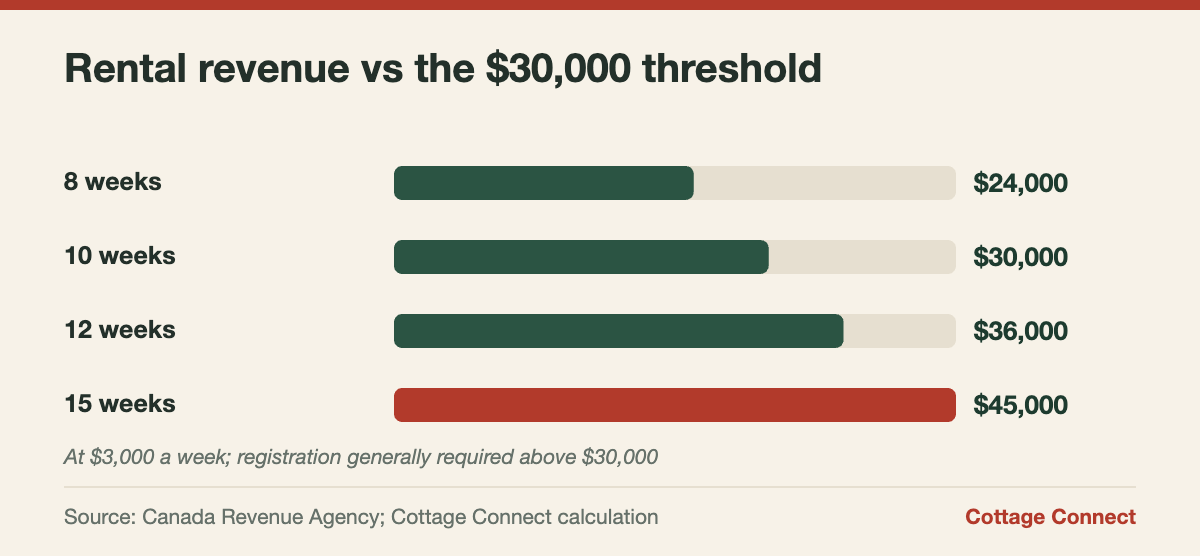
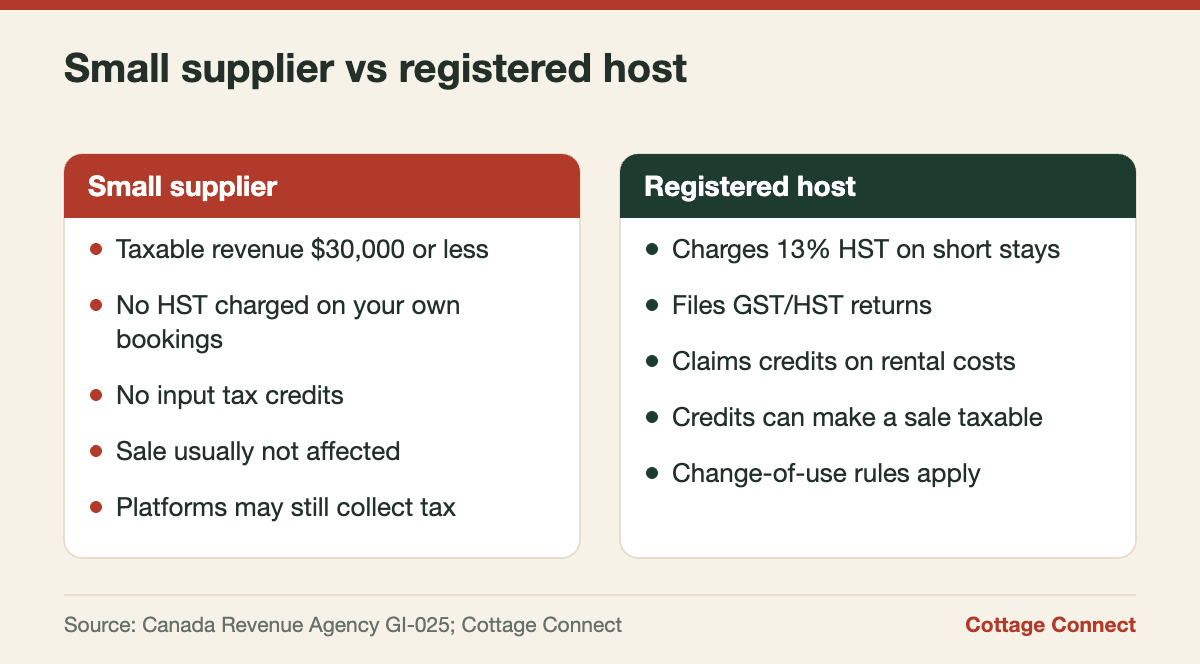
You’re a small supplier, and don’t have to register, if your taxable revenue is $30,000 or less over the last four consecutive calendar quarters and in any single quarter. The test counts all your taxable supplies, not just the cottage, so a side business adds to the total.
| Weeks rented at $3,000 | Annual rent | Over $30,000? |
|---|---|---|
| 8 | $24,000 | No |
| 10 | $30,000 | No (not more than $30,000) |
| 12 | $36,000 | Yes: registration generally required |
| 15 | $45,000 | Yes: registration generally required |
Watch the single-quarter test. A cottage that earns most of its rent between July and September could cross $30,000 inside one quarter even if the annual total is modest. The exact date registration takes effect depends on which test you failed, so check the CRA’s registration rules or ask an accountant as soon as you get close.
What happens once you register
- You charge 13% HST on short stays. On a $3,000 week, that’s $390 added to the guest’s bill.
- You file returns and send the tax collected to the CRA.
- You can claim input tax credits for HST you pay on rental-related costs, such as cleaning, repairs and supplies, in proportion to commercial use.
Credits on the purchase of the cottage itself are another matter. According to CRA info sheet GI-025, an individual who buys a property primarily (more than 50%) for personal use can’t claim a credit on the purchase, even if it’s rented sometimes. Partial credits are possible where rental use is 50% or more, and a full credit generally requires 90% or more commercial use.
GI-025 also says the method for measuring use must be fair and reasonable, such as comparing personal and rental days, and that counting every empty day as commercial use isn’t acceptable.
Should you register voluntarily?
Small suppliers can register voluntarily to claim credits on rental costs. For a cottage that’s mainly a family retreat, the credits are usually small, and the obligations (filing returns, charging guests more, possible tax on a later sale) are not. Voluntary registration tends to make more sense for a property run mainly as a rental business, and even then only after professional advice.
Booking platforms and HST
Under federal digital economy rules, large accommodation platforms are generally responsible for collecting GST/HST on short-term stays booked through them when the host isn’t registered. If you’re a registered host, you’re responsible for charging and remitting the tax yourself and need to give the platform your registration number. Check how your platform handles it, because the setup differs between platforms, and make sure tax isn’t being charged twice or not at all.
The trap: HST when you sell a rented cottage
For most owners, the sale of a used cottage is exempt from HST. GI-025 warns that this can change if you’ve claimed credits: in most cases where an individual has claimed an input tax credit on a vacation property, a later sale of that property by the individual is taxable. Sales of similar properties where no credit was claimed may be exempt.
The numbers can be large. HST of 13% on an $800,000 sale would be $104,000, although additional credits and rebates may reduce it. Change-of-use rules can also apply if rental or personal use shifts by 10% or more, which may require you to repay credits already claimed.
The safe order of operations is: talk to an accountant who handles GST/HST on real estate before you register voluntarily, before you claim any credit on the building, and again before you sell. Our post on capital gains on a cottage covers the income tax side of a sale.
Income tax and local rules still apply
HST is separate from income tax. Rental income is still reported on Form T776, and expenses for non-compliant short-term rentals are denied entirely, as we explain in cottage rental income tax. Some Ontario municipalities also charge a municipal accommodation tax on short stays, and many cottage townships now license short-term rentals. Our summary of short-term rental rules in cottage country is a starting point.
Tip: Keep a running quarterly total of your rental revenue, by booking date, from January onward. If a strong summer is going to push you past $30,000 in a single quarter, you want to know in August, not when you do your taxes in April.
Frequently asked questions
Do I have to charge HST on my cottage rental?
Only if you’re registered or required to be. Weekly and weekend rentals are taxable short-term accommodation, but owners whose taxable revenue is $30,000 or less over four calendar quarters, and in any single quarter, are small suppliers and don’t have to register. Above that, you generally must register and charge 13% HST.
Do I need to register for HST if I rent through a booking platform?
Not if you stay under the $30,000 small supplier threshold. In that case, large platforms are generally responsible for collecting GST/HST on stays booked through them. If you go over the threshold, or register voluntarily, you charge and remit the tax yourself and should give the platform your registration number.
Is the sale of a rented cottage subject to HST?
Usually not, if you never claimed input tax credits and the cottage was mainly for personal use. According to the CRA’s GI-025, where an individual has claimed credits on a vacation property, a later sale is in most cases taxable. Get advice before claiming credits on the building or registering voluntarily.
Is a monthly cottage rental subject to HST?
Generally no. Rentals of residential premises with continuous occupancy of one month or more are exempt from GST/HST. A cottage rented for the whole of July to one tenant would usually be exempt, while four separate weekly bookings in July would be taxable short-term accommodation.
Planning to rent your cottage?
Read our guide to renting your cottage for the practical side, and talk to an accountant before your first season so the tax setup matches how you plan to use the place.
This article is general information as of October 2026, not legal, tax, mortgage or financial advice. Rules and numbers change, so confirm the details for your situation with a licensed professional.