Capital gains on a cottage are taxed when you sell it, or are deemed to sell it, unless the gain is sheltered by the principal residence exemption. Half of the gain is added to your income for the year, because the planned increase in the inclusion rate was cancelled in March 2025. A cottage can be designated as your principal residence if your family ordinarily inhabits it, but only one property per family can be designated for each year.
Key takeaways
- The capital gains inclusion rate remains one-half in 2026; the proposed two-thirds rate was cancelled on March 21, 2025.
- A cottage can qualify as a principal residence even if you only use it seasonally.
- For years after 1981, a family unit can designate only one property per year.
- Designating the property with the higher gain per year usually saves the most tax.
- Every sale must be reported on Schedule 3 and Form T2091, even when no tax is owing.
How capital gains tax on a cottage is calculated
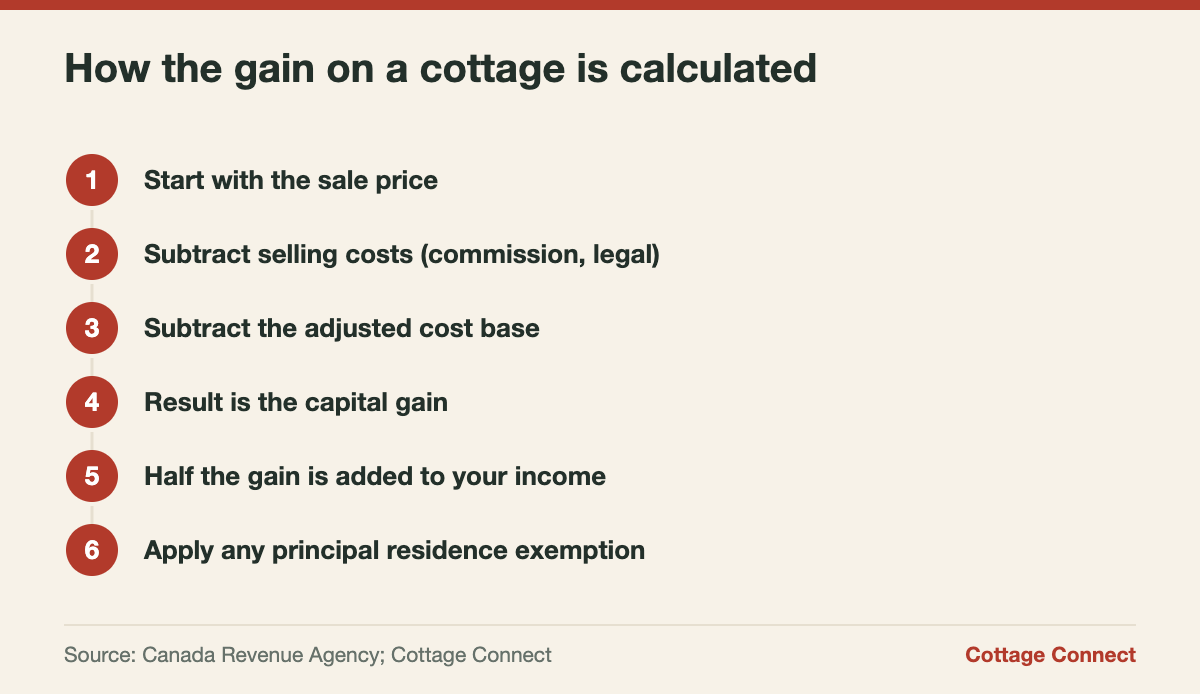
The gain is the sale price, minus your selling costs, minus your adjusted cost base (ACB). The ACB is what the cottage cost you: the purchase price, plus costs of buying it such as land transfer tax and legal fees, plus capital improvements. Routine repairs and maintenance don’t count.
Half of the gain, the taxable capital gain, is added to your income in the year of sale and taxed at your marginal rate. The federal government cancelled the proposed increase to a two-thirds inclusion rate on March 21, 2025, so the one-half rate still applies.
Worked example
Say you bought a cottage in 2008 for $300,000 and paid $5,000 in land transfer tax and legal fees. Over the years you replaced the septic system, rebuilt the dock and added a bedroom, for $90,000 in capital improvements. In 2026 you sell for $950,000 and pay $40,000 in commission and legal fees.
| Item | Amount |
|---|---|
| Sale price | $950,000 |
| Less selling costs | $40,000 |
| Less ACB ($300,000 + $5,000 + $90,000) | $395,000 |
| Capital gain | $515,000 |
| Taxable capital gain (50%) | $257,500 |
The $257,500 is added to your income. In Ontario, the top combined federal and provincial rate is about 53.5% once Ontario’s surtax is included, based on the CRA’s 2026 brackets. If the whole amount were taxed at that rate, the bill would be roughly $137,800. Your actual tax depends on your other income, and a large gain usually pushes most of it into the top brackets.
Can a cottage be your principal residence?
Yes. Under the CRA’s principal residence folio, a property qualifies for a year if it was ordinarily inhabited in that year by you, your spouse or common-law partner, or your children. A seasonal cottage you use every summer can meet that test. You don’t have to live there full-time.
The catch is the family limit. For 1982 and later years, a family unit (you, your spouse or common-law partner and your unmarried children under 18) can designate only one property for each year. If you own a home in the city and a cottage, you have to choose which one each year’s exemption goes to.
Which property should you designate?
The exempt part of a gain is calculated with a formula: the gain, multiplied by one plus the number of years designated, divided by the number of years owned. The extra year is meant to cover the overlap when you sell one home and buy another in the same year.
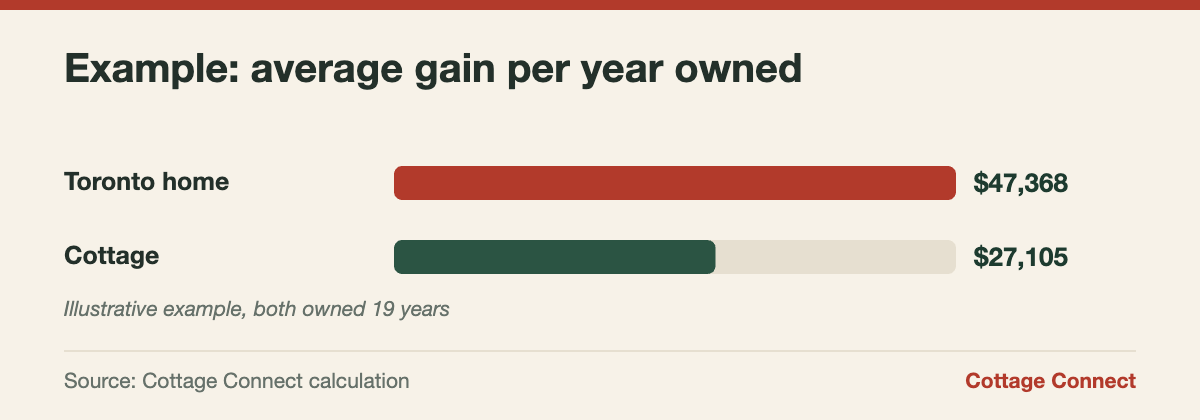
In practice, compare the average gain per year of ownership for each property, and give the exemption to the one with the higher number. Continuing the example, suppose you also owned a Toronto house from 2008 to 2026 that has gained $900,000:
- Toronto house: $900,000 over 19 years is about $47,368 a year.
- Cottage: $515,000 over 19 years is about $27,105 a year.
Here the house is the better use of the exemption, and the cottage gain is taxable. If the cottage had risen faster, the answer could be the reverse, or a split of years between the two. You don’t have to decide until you sell the first property, but you can’t designate the same years twice.
How to report the sale of a cottage
Since the 2016 tax year, the CRA requires you to report the sale of any property you designate as a principal residence. That means completing Schedule 3 and Form T2091 with your return for the year of sale, even if the whole gain is exempt. If the cottage isn’t being designated, the gain is reported on Schedule 3 as an ordinary capital gain.
The deadline is your regular filing date. Don’t skip the forms on the assumption that a fully exempt sale doesn’t need them.
Renting the cottage can affect the exemption
Occasional rentals don’t automatically disqualify a cottage, but heavy renting can. According to the CRA, a property whose main purpose is earning income may not be considered ordinarily inhabited. Converting a cottage to a full-time rental can also trigger a deemed sale at fair market value, and claiming capital cost allowance on it creates further complications.
Short-term rentals add another wrinkle. For tax years after 2023, the CRA denies all expenses for any period a short-term rental breaks provincial or municipal rules. If you rent, read our guide to renting your cottage and the local short-term rental rules in cottage country, and keep a log of personal and rental days.
Ways to keep the tax bill down
- Keep every improvement receipt. A new roof, septic system, dock, addition or well raises your ACB and lowers the gain. Ordinary repairs don’t.
- Check for a 1994 election. If the cottage was owned in February 1994, a capital gains election may have been filed with that year’s return, which can raise the ACB. Look for it in old tax files.
- Plan the designation early. Track the value of both properties so you know which one is earning the exemption.
- Think about family transfers. Selling or giving the cottage to a child is usually a disposition at fair market value. Our post on cottage co-ownership with family covers some of the shared-ownership issues.
Tip: Keep a cottage binder (or a folder in the cloud) with the purchase statement of adjustments, every invoice for capital work, the septic permit, the dock permit and your rental log. When you sell, decades later, your accountant will be able to prove an ACB that might otherwise be lost, and every documented dollar of improvement saves tax.
Frequently asked questions
Do I pay capital gains tax when I sell my cottage?
Yes, unless the gain is sheltered by the principal residence exemption. If your city home is designated for the same years, the cottage gain is taxable: half the gain is added to your income for the year of sale. Keep records of the purchase costs and improvements, because they reduce the gain.
What is the capital gains inclusion rate in 2026?
One-half. A proposal to raise the inclusion rate to two-thirds for gains above $250,000 for individuals was cancelled by the federal government on March 21, 2025. That means 50% of a capital gain on a cottage is added to your taxable income in 2026, the same as in previous years.
Can I claim my cottage as a principal residence if I live in Toronto?
Yes, if your family ordinarily inhabits the cottage during the year, which seasonal use can satisfy. But your family can designate only one property per year, so years used for the cottage can’t also shelter your Toronto home. Compare the gain per year on each before choosing.
Do I have to report the sale if the gain is fully exempt?
Yes. Since 2016, the CRA requires the sale of a designated principal residence to be reported on Schedule 3 and Form T2091 with your tax return for the year of sale. That applies even if no tax is owing. File the forms on time to avoid problems with the claim.
Planning to sell?
Start with a realistic value from our cottage value estimate, then take the numbers to your accountant. Our post on selling a cottage in the fall or spring covers timing, and land transfer tax on a cottage explains a cost that also counts toward your ACB.
This article is general information as of October 2026, not legal, tax, mortgage or financial advice. Rules and numbers change, so confirm the details for your situation with a licensed professional.